
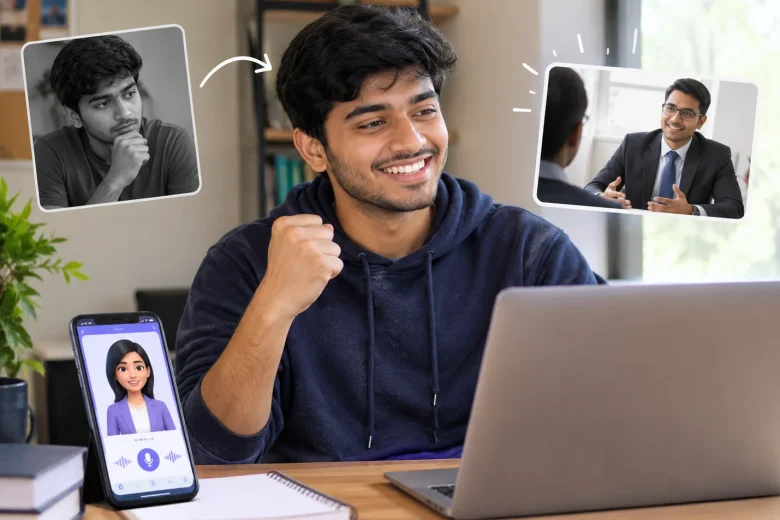
Discover how Sahil, a software developer from a Hindi-medium school, improved his English-speaking skills & cracked his interview communication with MySivi AI.
Sometimes, Your Biggest Career Problem Isn't Your Technical Skill
Imagine this.
You are sitting in a job interview.
The interviewer asks a question you already know the answer to.
You understand the technology.
You have worked on projects.
You have studied hard.
You know exactly what you want to say.
But then comes the difficult part.
You have to say it in English.
Suddenly, your mind starts racing.
“Am I saying this correctly?”
“What if my grammar is wrong?”
“What if I pronounce this word incorrectly?”
“What if the interviewer thinks my English is weak?”
You know the answer, but you can’t communicate it with the confidence you have in your head.
For many Indian students and professionals, this is a very real problem.
And this is where Sahil’s story becomes relatable.
Sahil, a software developer from a Hindi-medium background, had technical knowledge and career ambitions. But English communication was one area where he knew he needed to improve.
His journey wasn’t about becoming fluent overnight.
It wasn’t about memorising thousands of difficult words.
And it certainly wasn’t about pretending to have a foreign accent.
It was about something much more practical:
Learning to speak English confidently when it actually matters.
His journey eventually led him to MySivi—an AI-powered English-speaking app featuring an AI tutor named Arya.
Through regular speaking practice, real-life scenarios, personalised learning, and repeated conversations, Sahil worked on the gap between knowing English and actually speaking it.
And that journey helped him approach professional conversations and interviews with a completely different level of confidence.
🎥 Want to hear Sahil tell his story himself?
Watch Sahil’s full interview on YouTube
Quick Answer: How Did Sahil Improve His English Speaking Skills?
Sahil improved his English speaking skills by moving away from only studying grammar and vocabulary and focusing more on active speaking practice.
He explored different learning resources, practised conversations, worked on pronunciation and vocabulary, and eventually used MySivi to practise English through AI-powered conversations and practical scenarios.
The AI tutor Arya gave him a comfortable, judgment-free environment where he could speak, make mistakes, receive feedback, and try again.
His journey highlights one powerful lesson:
You don’t become confident by waiting until your English is perfect. You become confident by speaking regularly—even when it isn’t perfect.
Meet Sahil: A Software Developer Who Knew His Technical Skills Were Not Enough
Sahil’s story begins with an experience shared by thousands of young professionals in India.
He came from a Hindi-medium educational background.
Like many learners, he had studied English as a subject, but studying English and using English in real conversations are completely different experiences.
In school, you may learn:
- Grammar rules
- Tenses
- Vocabulary
- Sentence structures
- Reading comprehension
- Written English
But professional life asks different questions.
Can you introduce yourself confidently?
Can you explain your project?
Can you answer an unexpected interview question?
Can you participate in a team discussion?
Can you explain a technical problem to someone who isn’t technical?
Can you speak to a client?
Can you give a presentation?
That is where communication becomes a career skill.
And Sahil realised that his technical ability needed to be supported by stronger communication.
The Hidden Gap Between Knowing English and Speaking English
This is one of the biggest misconceptions about learning English.
People often say:
“I understand English, but I can’t speak it.”
That sentence tells us something important.
The learner may not have a problem with English knowledge.
They may have a problem with English practice.
Think about it.
You can understand what another person is saying.
You can read an English article.
You can watch an English video.
You may even know the grammar rules.
But speaking requires something extra.
You need to:
Think → Form a sentence → Choose the words → Pronounce them → Speak → Respond to the next question.
And you have to do all of this in real time.
That’s why speaking confidence cannot be developed through passive learning alone.
Sahil’s journey was essentially about closing this gap.
When Technical Knowledge Meets Communication Anxiety
For a software developer, interviews can be particularly challenging.
A candidate may spend months preparing:
- Data structures
- Algorithms
- Programming languages
- Projects
- System design
- Technical concepts
- Resume questions
But then an HR interviewer asks:
“Tell me about yourself.”
It’s not a coding question.
There is no IDE.
No compiler.
No Stack Overflow.
No time to Google.
It’s just you, your thoughts, and your ability to communicate them.
And for someone hesitant about speaking English, even a simple question can suddenly feel difficult.
Sahil understood that he needed to work on this.
Not because he lacked intelligence.
Not because he lacked technical skills.
But because he wanted his communication ability to match his professional ability.
Sahil Tried Different Ways to Learn English
Before finding the approach that worked best for him, Sahil explored multiple resources.
He used traditional grammar books.
He watched YouTube videos.
He explored English-learning communities like English-related WhatsApp channels.
He tried different English-learning apps, including platforms such as Duolingo and EngVarta.
Each resource had something useful.
But Sahil discovered an important limitation.
Learning content is not the same as having an actual conversation.
You can watch a 10-minute video about pronunciation.
But then someone asks you a question.
What happens?
You have to speak.
You can memorise 50 new vocabulary words.
But unless you use them in conversations, they may never become part of your active vocabulary.
You can study grammar for hours.
But during a fast conversation, you don’t have time to mentally calculate every grammatical rule.
Sahil needed something more practical.
He needed a place where he could speak repeatedly.
That search eventually brought him to MySivi.
Watch Sahil's Real Story
Reading about the journey is one thing.
Hearing Sahil explain it himself is another.
In the interview, he discusses his background, his communication challenges, the importance of English in professional life, the learning resources he explored, and how MySivi helped him practise speaking English.
🎥 Watch the full video:
Sahil’s MySivi English Learning Journey
You can also watch the second conversation for additional context about his experience:
🎥 Watch the second video:
The Turning Point: Discovering MySivi
When Sahil discovered MySivi, what stood out was the focus on actual communication.
MySivi isn’t simply about learning English as a subject.
The idea is to make English something you use.
With the MySivi English Speaking App, learners can practise conversations, explore different topics, work on pronunciation, develop vocabulary, and build confidence.
And one feature became particularly useful for Sahil:
Arya — The AI English Tutor
Arya gave Sahil something traditional learning methods often struggle to provide:
a conversation partner available whenever he wanted to practise.
No need to wait for a class.
No need to worry about whether another person is available.
No need to feel embarrassed after making a mistake.
He could practise.
Pause.
Try again.
Ask questions.
Make mistakes.
Learn.
And repeat.
For someone dealing with speaking hesitation, that creates a very different learning environment.
Why a Judgment-Free Environment Matters
Let’s talk about something that isn’t always discussed in English-learning advice:
Fear.
Fear of making mistakes can be more powerful than a lack of vocabulary.
A learner might know the correct sentence but still refuse to speak because they are worried about being judged.
That creates a cycle:
Fear → Less speaking → Less practice → Low confidence → More fear
MySivi helps reverse that cycle by giving learners a comfortable environment to practise.
The new cycle becomes:
Speak → Make mistakes → Receive feedback → Improve → Speak again → Build confidence
That difference may look small.
But for a learner who has avoided speaking English for years, it can be a major psychological shift.
How Sahil Used MySivi to Build His Speaking Confidence

Sahil’s journey can be understood through several important stages.
Step 1: He Stopped Waiting for Perfect English
One of the first lessons from Sahil’s experience is that you don’t need perfect English to begin speaking.
This is where many beginners get stuck.
They think:
“First I need to learn grammar.”
Then:
“I need more vocabulary.”
Then:
“My pronunciation isn’t good.”
Then:
“I’ll start speaking once I’m ready.”
The problem?
You may never feel ready.
Speaking itself is part of learning.
Sahil began focusing on communication rather than perfection.
That meant allowing himself to make mistakes.
And that is actually a powerful learning strategy.
Step 2: He Practised Interview Conversations
Because career growth was one of his motivations, interview practice became especially valuable.
Instead of only reading interview answers online, he could practise responding to questions aloud.
For example:
“Tell me about yourself.”
A simple question—but one that can make nervous candidates freeze.
With repeated practice, you can learn how to structure your answer:
Present → Experience → Skills → Achievement → Career goal
Similarly, questions such as:
- What are your strengths?
- What are your weaknesses?
- Why should we hire you?
- Tell me about your project.
- Why do you want to join our company?
- Where do you see yourself in five years?
- Tell me about a difficult problem you solved.
- How do you handle pressure?
become easier when you have already practised expressing your thoughts aloud.
The goal isn’t to memorise one perfect answer.
It’s to develop the ability to think and respond in English.
Step 3: He Worked on Pronunciation
Knowing a word and pronouncing it confidently are two different things.
This is particularly important for professional vocabulary.
Words such as:
- Opportunity
- Development
- Collaboration
- Technology
- Responsibility
- Experience
- Communication
can appear frequently in interviews and professional conversations.
With speaking practice and feedback, learners can become more aware of how they pronounce words.
And that awareness matters.
Because sometimes you don’t even know which words you’re mispronouncing until somebody—or something—points them out.
This is one area where an AI English teacher can provide useful repetition and feedback.
Step 4: He Expanded His Active Vocabulary
Sahil also worked on vocabulary.
But the important part wasn’t simply learning difficult words.
It was using them naturally.
For example, knowing the word “collaborate” is useful.
But being able to say:
“I collaborated with my team to solve the issue.”
is much more valuable in an interview.
Similarly:
Leverage
can become:
“I leveraged my technical experience to improve the project.”
And:
Optimise
can become:
“I optimised the process to improve performance.”
This is the difference between passive vocabulary and active vocabulary.
The words you recognise are not always the words you can immediately use while speaking.
Regular conversations help turn vocabulary into usable language.
Step 5: He Practised Beyond the Interview
Interview preparation was important, but Sahil’s journey wasn’t limited to interviews.
Real English communication happens everywhere.
At work.
With colleagues.
During presentations.
On calls.
In meetings.
While networking.
During casual conversations.
That’s why MySivi’s scenario-based approach can be useful.
Instead of repeatedly practising the same textbook dialogue, learners can work with situations that resemble everyday and professional communication.
This makes learning feel less like homework and more like preparation for real life.
Step 6: He Used Peer-to-Peer Conversations
AI practice can create a safe starting point.
But eventually, learners also need to experience conversations with other people.
MySivi’s peer-to-peer conversation ecosystem gives learners opportunities to practise with other English learners.
That introduces another challenge:
real-time unpredictability.
A human conversation doesn’t always follow a script.
Someone may ask a question you weren’t expecting.
They may use a different expression.
They may change the topic.
You have to listen.
Think.
Respond.
And keep the conversation moving.
That is exactly the kind of experience that helps transform classroom English into conversational English.
The 15–20 Minute Rule: Why Short Practice Can Be Powerful
One of the most practical lessons from Sahil’s journey is the importance of consistency.
Many learners make the same mistake:
They try to study too much at once.
They practise for two hours on Sunday.
Then nothing for the next six days.
Instead, a shorter daily routine can be easier to maintain.
For example:
A 20-Minute English Speaking Routine
5 minutes — Vocabulary
Learn 3–5 useful words or expressions.
10 minutes — Speaking
Have an AI conversation or speak aloud about a topic.
5 minutes — Review
Identify mistakes, difficult words, pronunciation issues, and sentences you want to improve.
That’s it.
Twenty focused minutes.
The goal isn’t to create another stressful task.
It’s to create a habit.
Because language learning isn’t a sprint.
It’s repetition.
What Changed for Sahil?
The biggest change wasn’t simply vocabulary.
It wasn’t grammar.
It wasn’t pronunciation.
It was confidence.
Before regular speaking practice, the thought of communicating in English could create hesitation.
After practising repeatedly, English became less intimidating.
He became more comfortable expressing his thoughts.
And this is a critical distinction:
Fluency isn’t only about speaking faster.
It is also about thinking less about the fear of making mistakes.
When the fear decreases, communication becomes more natural.
The Moment That Matters: Walking Into an Interview Differently
Now imagine Sahil entering an interview after his practice.
Same technical knowledge.
Same qualifications.
Same professional experience.
But something is different.
His mindset.
Instead of thinking:
“What if my English is wrong?”
He can focus on:
“How can I explain my answer clearly?”
That shift changes the interview experience.
He can listen better.
He can structure his answers.
He can explain his projects.
He can communicate his strengths.
He can ask questions.
Most importantly, he can allow the interviewer to see the person behind the resume.
And that is what communication is supposed to do.
It should help your skills become visible.
Sahil's Story Isn't Just About Cracking an Interview
It’s tempting to look at a success story and think:
“Great. He used an app and got a job.”
But there is a deeper lesson here.
Sahil’s story is about removing a communication barrier.
His technical knowledge was already valuable.
English wasn’t his identity.
It was a skill he wanted to develop.
And that mindset is powerful.
You don’t have to become someone else to speak English.
You don’t have to lose your accent.
You don’t have to stop speaking Hindi.
You don’t have to pretend to be a native speaker.
You simply need to become comfortable communicating your ideas.
English Doesn't Replace Your Mother Tongue
Learning English isn’t about abandoning your native language.
It is about adding another communication tool.
Hindi can remain your mother tongue.
English can become another language you use for:
- Global communication
- Career opportunities
- Technology
- Education
- Interviews
- Professional networking
- Travel
- International workplaces
Think of it as adding another skill to your toolkit.
For a software developer, learning another programming language can increase possibilities.
In the same way, improving English communication can expand professional possibilities.
More communication skills. More opportunities to be heard.
Why MySivi Is Different From Simply Watching English Videos
YouTube is an amazing learning resource.
You can find pronunciation lessons, vocabulary videos, grammar explanations, interviews, podcasts, and conversations.
But there is one major limitation:
You are mostly watching.
English speaking requires you to participate.
That’s where an AI app for English speaking practice can complement traditional learning.
Instead of:
Watch → Understand → Close the video
You can follow:
Speak → Receive feedback → Correct → Speak again
The second cycle is much closer to the actual skill you’re trying to develop.
Why AI Can Be a Useful English Learning Partner
Human teachers remain valuable.
But they also have practical limitations.
A teacher has limited time.
A speaking partner may not always be available.
A conversation group may operate at a fixed time.
And some learners feel uncomfortable making repeated mistakes in front of another person.
AI changes the availability equation.
With an AI English tutor, learners can practise when they have time.
Morning.
Evening.
During a break.
At home.
Before an interview.
After work.
The flexibility makes consistent practice easier.
And consistency is the real secret sauce.
MySivi Features That Support English Speaking Practice
Sahil’s experience highlights why learners increasingly look beyond traditional grammar-focused learning.
AI English Tutor — Arya
Practise conversations with an AI tutor in a comfortable, judgment-free environment.
Conversation Practice
Speak instead of only reading. Build the habit of forming and expressing thoughts in English.
Real-Life Scenarios
Practise topics connected to interviews, professional communication, presentations, daily conversations, and other situations.
Pronunciation Improvement
Become more aware of pronunciation and work on difficult words through repeated practice.
Vocabulary Development
Learn vocabulary in context and use new words while communicating.
Peer-to-Peer Practice
Move from AI conversations to real conversations with other learners.
Personalized Progress
Focus on the areas where you need more practice instead of following exactly the same path as everyone else.
Interactive Learning
Quizzes, practice activities, feedback, and progress-oriented learning can make English practice more engaging.
MySivi vs Traditional English Learning: What's the Difference?
Traditional Approach | MySivi Approach |
Memorise grammar | Practise communication |
Watch lessons | Participate in conversations |
Learn vocabulary lists | Use vocabulary in context |
Fixed learning schedule | Flexible practice |
Fear of making mistakes | Judgment-free AI practice |
Generic content | Personalised practice |
Passive learning | Active speaking |
Limited speaking time | Repeated conversation practice |
The point isn’t that traditional learning is useless.
Grammar matters.
Vocabulary matters.
Reading matters.
Listening matters.
But if your goal is to speak English fluently, speaking itself has to be part of the routine.
The Real Reason English Learners Get Stuck
Let’s break it down.
Problem 1: “I don’t have enough vocabulary.”
Solution: Learn useful words and immediately use them in sentences.
Problem 2: “I’m afraid of making mistakes.”
Solution: Create a safe environment where mistakes become part of practice.
Problem 3: “I understand English but can’t respond quickly.”
Solution: Practise spontaneous conversations.
Problem 4: “My pronunciation isn’t clear.”
Solution: Speak aloud and actively work on pronunciation.
Problem 5: “I don’t have anyone to practise with.”
Solution: Use an AI English tutor and peer-to-peer practice.
Problem 6: “I don’t have enough time.”
Solution: Build a manageable 15–20 minute daily routine.
This is why the right learning system isn’t just about content.
It is about practice + feedback + consistency.
A Simple English Speaking Plan Inspired by Sahil's Journey
If you’re starting today, try this:
Day 1–5: Remove the Fear
Speak for 10–15 minutes every day.
Talk about yourself, your family, your education, your work, or your interests.
Don’t stop every time you make a mistake.
Keep going.
Day 6–10: Build Your Vocabulary
Choose 5 useful words every day.
Don’t just memorise definitions.
Use each word in a sentence.
Day 11–15: Practise Professional English
Start practising:
- Self-introduction
- Interview questions
- Project explanation
- Strengths and weaknesses
- Career goals
- Workplace conversations
After Day 15: Keep Going
Don’t stop because you completed 15 days.
That’s when the habit should become stronger.
15 days can start the journey. Consistency builds the skill.
What Makes Sahil's Story So Relatable?
Because he didn’t start as someone who had perfect English.
He started with hesitation.
He explored different options.
He discovered what kind of practice he actually needed.
He used technology.
He practised.
He made mistakes.
He improved.
And eventually, he became more confident communicating professionally.
That makes his story different from a generic “learn English in 30 days” advertisement.
There is no magic trick here.
There is a process.
Practice. Feedback. Repetition. Confidence.
Is MySivi Only for Job Interviews?
No.
Interview preparation is one practical use case, but English communication is much broader.
MySivi can support learners who want to practise:
- Daily English
- Spoken English
- Workplace communication
- Interview English
- Presentation skills
- Vocabulary
- Pronunciation
- Conversation
- Professional communication
- Confidence-building
Whether you’re a college student preparing for your first interview or a working professional trying to communicate more confidently, the objective is the same:
Turn English knowledge into English communication.
Who Can Benefit From an AI English Speaking App?
An AI English-speaking app can be particularly useful for:
Students
Students preparing for placements, presentations, group discussions, and interviews.
Software Developers
Developers who want to communicate technical ideas confidently during interviews, meetings, and client interactions.
Job Seekers
Candidates who know their subject but struggle to express themselves in English.
Working Professionals
Professionals who want to improve workplace communication and presentation skills.
Beginners
Learners looking for fluent English-speaking practice for beginners in a comfortable environment.
Global Job Aspirants
People preparing to communicate with international teams and companies.
Can I learn English even if I come from a Hindi-medium background?
Absolutely.
Your educational background does not decide your future English-speaking ability.
You may need more practice and exposure, but speaking confidence can be developed over time.
Sahil’s journey is one example of how consistent practice can help bridge that gap.
The Bottom Line: Your English Doesn't Have to Hold Your Talent Back
Sahil’s story started with a familiar problem:
He had the knowledge, but he wanted the confidence to communicate it better.
He explored different resources.
He understood that grammar alone wasn’t enough.
He realised that speaking required speaking practice.
He found an AI-powered practice environment through MySivi.
He used Arya to practise conversations.
He worked on vocabulary and pronunciation.
He explored real-life scenarios.
He built consistency.
And slowly, the fear of speaking became less powerful.
That’s the real success story.
Not becoming “perfect.”
Not speaking with a fake accent.
Not memorising complicated vocabulary.
But becoming confident enough to say:
“I know what I want to say—and I can communicate it.”
If you’re a student, developer, job seeker, or professional who understands English but hesitates to speak, don’t let that hesitation decide how far your career can go.
Your technical skills matter.
Your education matters.
Your experience matters.
And your ability to communicate those strengths matters too.
So start small.
Start with one conversation.
Then another.
Then another.
Speak. Make mistakes. Learn. Repeat.
Because confidence isn’t something you wait for.
You build it—one conversation at a time.
Start your English-speaking journey with MySivi AI.
Your next interview deserves to hear what you know.

Sahil Gupta creates content around the MySivi app, helping learners improve their English speaking through simple, effective, and real-world methods, turning study stuff into simple, actually useful content. He shares English hacks, exam prep tips, and shows how to level up your speaking with MySivi’s AI-powered learning and real convo practice no fluff, just results