

Learn English Translation with MySivi, understand sentence structure, avoid literal translation mistakes, and turn translated ideas into natural English speaking.
Struggling to flip the switch from your native language to fluent English? You are definitely not alone. Most of us get stuck in the endless loop of “mental translation”, painfully building a sentence in our head, translating it word-for-word, and freezing before we can even speak.
Enter MySivi, the ultimate AI-powered app that is completely changing the language-learning game. Think of it as your judgment-free, 24/7 personal conversation partner that turns rigid, boring translation rules into effortless, natural fluency.
Whether you want to nail Hindi to English, Tamil to English, or bridge the gap from 15+ other global tongues, here is how the MySivi app, along with its genius AI Teacher, Arya, helps you master English translation like a pro.
Zero Language Barriers: 15+ Multilingual Scaffolding
Let’s be real: jumping straight into a 100% English-only environment can feel like an absolute brick wall. MySivi gets rid of that anxiety by meeting you exactly where you are. The platform offers a powerful multilingual safety net supporting 15+ regional and global languages:
- Indian Languages: Hindi, Tamil, Telugu, Kannada, Marathi, Bengali, Urdu, and more.
- Global Languages: Spanish, French, German, Arabic, Russian, and Portuguese.
No matter your starting point, you can ask questions or prompt the AI in your mother tongue, creating a secure, comfortable bridge while you build up your vocabulary.
Seamless Real-Time Translation Training
MySivi doesn’t just teach you English; it actively shows you how your native thoughts map out into flawless English structure. You can drop text using Hinglish, pure Hindi script, or Tamil, and watch the magic happen instantly.
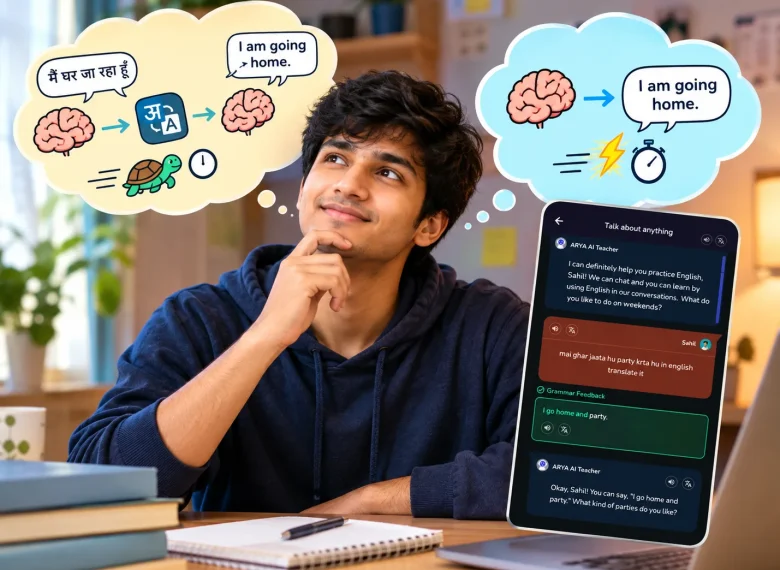
As seen in many people who use MySivi AI-based English-speaking app chat sessions with ARYA AI Teacher:
- Hinglish / Romanized Input: When X person or any person who is using the app types “mai ghar jaata hu party krta hu in english translate it”, the app immediately serves up clean Grammar Feedback: “I go home and party.”
- Native Script Input: If someone who is already using the MySivi app inputs the Hindi script “मै घर जा रहा in English translate it”, and Arya instantly translates it to “I am going home.”
- Regional Support: If anyone who is already using the MySivi app he/she can easily switch gears to Tamil, typing “நீங்கள் எப்படி இருக்கிறீர்கள்? in English translate it”, and receive a flawless “How are you?” translation instantly.
The "Explanation" Feature: Learn the Why, Not Just the What
Literal translation is a major trap; it makes your English sound stiff and robotic. MySivi solves this with its dedicated Explanation Toggle.
When anyone who is using the AI-powered English-speaking app MySivi translates his Hindi prompt, the AI doesn’t just hand over the answer. It explicitly breaks down the mechanics: “This is a translation from Hindi to English. The sentence structure is changed to reflect proper English grammar for ‘I am going home.‘”
By teaching you the structural differences between languages, MySivi trains your brain to break free from standard word-for-word decoding, preventing Mother-Tongue Interference (MTI).
Meet Arya: The Ultimate AI English Tutor
What makes MySivi a total vibe is that it isn’t a static textbook. It’s powered by Arya, a conversational AI chatbot that keeps the momentum going.
Instead of ending the lesson after a single translation, Arya seamlessly flips the script into a flowing conversation. After translating a person’s text, she immediately keeps the chat alive by prompting: “What kind of parties do you like?” or “What kind of movies do you like to watch?”
This real-time execution forces you to actively use the newly translated phrases in actual context, locking down your verbal muscle memory.
Why MySivi is a Total Game-Changer for Learners
- Context-Based Levels: Practice your translation skills in high-stakes, real-world simulations like mock job interviews, corporate networking events, or casual café orders.
- No-Judgment Zone: Zero preachy lectures or awkward silences. You can stagger, mispronounce, or mess up your translations as many times as you need until it clicks.
- Fluid Conversion: It smoothly transitions you from a bilingual translation learner to a confident, direct English speaker.
How to Maximize MySivi for English Translation

- Type or speak naturally in your native language (Hindi, Tamil, etc.).
- Review the immediate Grammar Feedback to see the correct English sentence structure.
- Tap “Explanation” to understand why the phrasing changes.
- Keep chatting with Arya to use your new vocabulary in a live, organic conversation.
Stop memorizing boring dictionary tables. Download MySivi today, drop your native language in the chat, and let Arya help you unlock fluent English!
Do you find yourself thinking in Hindi first and then trying to translate into English before you speak? It’s a common starting point for many learners in India. You use tools like Google Translate to understand words, but when it’s time to speak, you feel slow, awkward, and unsure if your sentences sound natural. This gap between knowing the words and using them confidently is frustrating.
What if you could use translation as a bridge, not a barrier? This guide will show you how to learn English through translation effectively, avoid common pitfalls, and quickly move towards thinking and speaking directly in English. We’ll explore how an AI English-speaking partner can help make this transition smooth and fast.
The Quick Answer: How to Learn English by Translation
To learn English effectively through translation, use it as a tool to understand vocabulary and basic sentence structure, not as a method for real-time conversation. Focus on translating ideas, not individual words. The fastest way to improve is to then practice speaking these translated concepts aloud with an English-speaking app like MySivi AI, which corrects your structure and helps you start thinking directly in English.
Key Takeaways
Translation is a starting point: Use Hindi-to-English translation to build your initial vocabulary and grasp concepts.
Avoid word-for-word traps: Literal translation often leads to grammatically incorrect or unnatural-sounding English sentences.
Focus on context and ideas: Translate the meaning behind your thoughts, not just the words themselves.
Move from translating to speaking: The goal is to stop translating in your head. Practice with an AI English tutor like the MySivi app to build speaking fluency.
Get instant feedback: Use an AI tool to correct mistakes in sentence structure and pronunciation that come from translation habits.
Why We Translate First: The Natural Habit for Indian Learners
For most of us in India, thinking in our native language (like Hindi, Tamil, or Bengali) and then translating to English is a natural first step. It feels safe. You know what you want to say in Hindi, and you use tools for Hindi-to-English translation to find the right words.
This method is useful when you’re a beginner. It helps you:
Build Vocabulary: Quickly learn the English words for things you already know in Hindi.
Understand Basic Concepts: See how a sentence in Hindi maps to an English translation.
Gain Initial Confidence: It gives you a way to start communicating, even if it’s slow.
According to a survey by Cambridge University Press, a significant number of English learners globally use translation as a primary learning strategy. However, the real challenge begins when you try to move from writing to speaking.
The "Translation Trap": Why Thinking in Hindi Slows You Down
Relying too much on real-time translation creates a major roadblock to fluency. This is a crucial point many spoken English learning guides miss. When you translate in your head during a conversation, you are doing two jobs at once: thinking in Hindi and then performing a complex translation into English.
This leads to common problems:
Hesitation and Pauses: You pause often, searching for the exact word, which makes your speech sound unnatural.
Incorrect Grammar and Phrasing: Hindi and English have different sentence structures (Subject-Object-Verb vs. Subject-Verb-Object). Direct translation often results in errors.
Loss of Confidence: The fear of making these mistakes can make you anxious about speaking altogether.
Common Hindi-to-English Translation Mistakes
Let’s look at some practical examples of how literal Hindi-to-English sentence translation can go wrong. This is where an AI English teacher becomes invaluable by catching these subtle but important errors.
Think in Hindi → Speak Natural English
| ⚠️ Literal Translation | ✅ Natural English to Say |
मैं अपना काम कर रहा हूँ। Main apna kaam kar raha hoon. | ❌ I am doing my work. Grammatically okay, but can sound unnatural in everyday conversation. | 💬 I’m working. 💬 I’m busy with my work. |
आपका शुभ नाम क्या है? Aapka shubh naam kya hai? | ❌ What is your good name? | 💬 What’s your name? 💬 May I know your name? |
वह मेरे से लम्बा है। Vah mere se lamba hai. | ⚠️ He is taller than me. Common and grammatically accepted in everyday English. | 💬 He’s taller than me. (Common) 💬 He’s taller than I am. (More formal) |
चलो मूवी देखने चलते हैं। Chalo movie dekhne chalte hain. | ❌ Let’s go for seeing a movie. | 💬 Let’s go see a movie. 💬 Let’s go to the movies. |
 What You Think in Hindi
The takeaway
Don’t translate every Hindi word into English. Translate the meaning, then speak it naturally.
How to Move from Translation to Fluent Speaking
The goal is to train your brain to think directly in English. Here’s a step-by-step guide to do just that, using translation as a launchpad.
Step 1: Use Translation for Vocabulary, Not Conversation
Continue using English-to-Hindi or Hindi-to-English dictionaries and tools to learn new words. When you learn a new word like “efficient,” don’t just learn its Hindi meaning (कुशल). Instead, learn it in a full English sentence: “The new software is very efficient.” This builds context.
Step 2: Practice with Hindi-to-English Translation Sentences
Start with simple English translation practice. Take 5-10 common sentences you use daily in Hindi and translate them into English. Don’t use a translator tool at first. Write them down, then check them with a tool like Google Translate (Hindi to English) or an app like MySivi. This exercise trains you to understand sentence formation.
Step 3: Start Thinking in English for 5 Minutes a Day
This is the most important step. Begin by thinking in simple English sentences.
Describe your surroundings: This is my laptop. The wall is white. I am sitting on a chair.”
Narrate your actions: “I am drinking water now. I need to send an email. I will go to the market later.”
This small habit, as mentioned in many expert public speaking tips, builds the neural pathways for thinking in English.
Step 4: Use an AI Speaking Partner for Real Practice
This is where you bridge the gap. You can’t get fluent just by thinking; you have to speak. An AI partner like MySivi AI is the perfect tool for English speaking practice because it provides a safe, judgement-free environment.
Unlike just reading or translating, MySivi AI forces you to produce the language yourself. You can have conversations on topics like job interviews or daily life. Your AI English tutor doesn’t just listen; it gives you instant feedback on your sentence structure, grammar, and pronunciation, helping you break free from Hindi-based sentence patterns.
Key Features That Make MySivi AI Stand Out:
Contextual Conversations: Practice real-life scenarios like ordering food or attending a meeting. This is far more effective than translating isolated sentences.
Instant Sentence Structure Feedback: MySivi AI immediately points out when your sentence sounds unnatural because of direct translation, suggesting a better way to phrase it.
Pronunciation Analysis: Get a detailed breakdown of your pronunciation, helping you sound clearer and more confident.
Personalised Learning: The AI remembers your common mistakes and focuses your practice on those weak spots, making your English speaking learning journey faster.
Frequently Asked Questions(FAQs)
You can build vocabulary and basic understanding through translation, but you won’t achieve fluency. To speak confidently, you must practice speaking and thinking in English, which is where an AI English-speaking app becomes essential.
Hindi-to-English translation with Google is a powerful tool for understanding the gist of a text or finding a specific word. However, for nuanced or complex sentences, it can produce unnatural or grammatically incorrect results because it struggles with cultural context and idiomatic language.
Start by thinking in simple English for a few minutes every day. Narrate your actions or describe your surroundings. Gradually increase the complexity. Consistent English speaking practice with a partner, like MySivi AI, is the fastest way to make this shift permanent.
Translate short paragraphs from a Hindi newspaper or story into English. Focus on conveying the core message, not a literal word-for-word translation. Then, compare your version with a professional translation to see how you can improve your phrasing.
An AI speaking English app like MySivi AI analyzes your spoken sentences in real-time. It identifies awkward phrasing and grammatical errors that often come from direct Hindi-to-English translation and provides immediate, corrected alternatives, helping you learn the natural way to speak.
Start by building a small daily habit. Spend 10 minutes learning new vocabulary using translation, and 15 minutes practicing speaking those words in conversations with an AI tutor. Consistency is more important than the length of your practice sessions.
Yes, MySivi is designed to help users who think in a native language like Hindi transition to speaking fluent English. Its focus on real-world conversation practice and instant feedback on sentence structure directly addresses the most common challenges faced by Hindi speakers.
Conclusion
Learning English through translation is a valid starting strategy, but it’s not the final destination. The key to fluency is to use translation to build your foundation and then actively practice thinking and speaking directly in English. Stop letting the habit of mental translation hold you back. By dedicating time to thinking in English and using a powerful tool for speaking English practice, you can make that leap.
Ready to stop translating and start speaking? Download the MySivi app and have your first conversation with your AI English tutor today.

Sahil Gupta creates content around the MySivi app, helping learners improve their English speaking through simple, effective, and real-world methods, turning study stuff into simple, actually useful content. He shares English hacks, exam prep tips, and shows how to level up your speaking with MySivi’s AI-powered learning and real convo practice no fluff, just results

