
Discover the best Vocabulary Building Apps to help students ace exams and speak confidently. See how AI-powered tools like MySivi can transform your learning.
Feeling stuck with the same English words in your essays and conversations? For students in India, a strong vocabulary isn’t just for passing exams like the CAT or UPSC; it’s the key to confident interviews, clearer presentations, and better opportunities. But memorizing long lists of words from a book is slow and boring.
The right app can change everything. Using smart technology, these tools make learning new words faster, more engaging, and much more effective. They help you understand words in context, practise them until they stick, and actually use them when you speak.
Quick Answer
The best vocabulary-building app for students is MySivi AI, which uses AI-powered conversations to help you practise new words in real-life scenarios. Other top apps include Vocabulary.com for its adaptive learning game, Memrise for video-based learning, and Anki for its powerful flashcard system.
Key Takeaways
Context is Key: The best apps teach you words in sentences and conversations, not just as definitions.
Spaced Repetition Works: Look for apps like Anki, Memrise, and MySivi that use scientifically backed methods to help you remember words over the long term.
Active Practice is Crucial: Learning a word is one thing; using it is another. Apps that include speaking practice, like MySivi, bridge this gap effectively.
Personalization Matters: Top apps adapt to your level and focus on the words you find most difficult, saving you time.
1. MySivi AI – Best for Spoken Practice & Real-World Use
MySivi isn’t just another flashcard app; it’s an AI English speaking app designed to help you use new vocabulary confidently in actual conversations. Many students learn words but freeze when they have to speak. MySivi solves this by providing a safe space to practice with an AI English tutor that feels like talking to a real person.
You learn a new word and can immediately use it in a mock job interview, a conversation about travel, or a group discussion, all within the app. Your AI English tutor gives you instant feedback on not just your vocabulary choice, but also your pronunciation and grammar. This makes it one of the top vocabulary improvement apps because it connects learning to real-world application.
Key Features That Make MySivi AI Stand Out:
AI-Powered Conversations: Practise using new words in hundreds of real-life scenarios (interviews, daily chats, presentations) with an AI that understands and responds to you.
Instant Feedback: Get immediate, private feedback on your word choice, pronunciation, grammar, and fluency so you know exactly what to improve.
Personalized Learning Path: The AI tracks your performance, identifies your weak spots, and suggests specific topics and words for you to work on.
Progress Tracking: Watch your active vocabulary, fluency, and pronunciation scores improve over time with detailed analytics.
MySivi is the ideal English vocabulary builder app for students who want to build a practical vocabulary for interviews, competitive exams, and professional life.
2. Vocabulary.com – Best for Gamified Learning
Vocabulary.com turns learning new words into an addictive game. It’s a scientifically validated vocabulary tool that uses an adaptive system to figure out which words you know and which you need help with. As you answer questions, the app personalizes your learning, focusing on your weak spots.
It’s excellent for building a broad vocabulary base, especially for standardized tests like the GRE, GMAT, or SAT. The platform boasts over 15,000 words with 230,000+ questions, making it one of the most comprehensive vocabulary apps for students.
Pros: Highly engaging game format, adaptive technology, great for exam preparation.
Cons: Less focus on spoken practice, can feel repetitive over time.
3. Anki – Best for Customizable Flashcards
Anki is a powerful, no-frills flashcard app that uses a sophisticated Spaced Repetition System (SRS). This algorithm, backed by memory science, shows you cards just before you’re about to forget them, making your study sessions incredibly efficient.
It’s fully customizable, allowing you to create your own decks with images, audio, and text. You can also download thousands of pre-made decks shared by other users on topics ranging from academic English to medical terminology. It is one of the best vocabulary learning apps for serious students who want full control over their study material.
Pros: Extremely effective SRS algorithm, highly customizable, free on desktop and Android.
Cons: Steep learning curve, interface feels dated compared to other modern vocabulary apps.
4. Memrise – Best for Video-Based Learning
Memrise makes learning feel less like studying and more like entertainment. Its standout feature is Learn with Locals, which uses thousands of short video clips of native speakers using words and phrases in natural contexts. This helps you understand pronunciation and tone in a way that text-based apps can’t.
While it started as a flashcard app using SRS, it has evolved into a more immersive language learning platform. It’s an excellent app for learning new words if you are a visual or auditory learner.
Pros: Real-world context with videos, user-friendly interface, good variety of courses.
Cons: The free version is quite limited.
5. WordUp – Best for Building a Knowledge Map
WordUp takes a unique approach. Instead of teaching you random words, it builds a knowledge map of the words you already know and then shows you which words are most important to learn next. It prioritizes vocabulary based on frequency of use and importance, helping you learn the most useful words first.
Each word comes with definitions, examples, and videos from movies or news clips, showing you the word in context. This makes it one of the best apps to build English vocabulary in a logical, structured way.
Pros: Smart prioritization of words, great contextual examples, visually appealing interface.
Cons: Can be overwhelming with the amount of information presented for each word.
6. Quizlet – Best for Traditional Study Methods
Quizlet is a hugely popular study app that goes beyond just vocabulary. Students can create their own study sets or use millions of sets created by others. It offers several study modes, including flashcards, matching games, and practice tests.
It’s a versatile vocabulary quiz app perfect for school and college students who need to memorize specific sets of terms for an exam. For example, you can easily find a deck for your chemistry class or a list of words for the IELTS exam.
Pros: Incredibly versatile, massive library of user-generated content, multiple study modes.
Cons: Quality of user-generated sets can vary, not specifically focused on long-term vocabulary retention.
7. Elevate – Best for Overall Brain Training
Elevate is more than just a vocabulary builder app; it’s a brain training program designed to improve a range of cognitive skills, including memory, processing speed, and comprehension. It features over 40 games, many of which are designed to enhance your vocabulary and writing skills.
While not solely focused on vocabulary, its engaging, polished games make learning feel effortless. If you want to improve your overall communication skills, not just memorize definitions, Elevate is a great choice.
Pros: Polished and fun games, targets a wide range of cognitive skills, personalized daily workouts.
Cons: Requires a subscription for full access, less focused on deep vocabulary learning for specific exams.
Comparison of the Best Vocabulary Building Apps
Feature | MySivi AI | Vocabulary.com | Anki | Memrise |
Primary Method | AI Conversation | Gamified Quizzes | Spaced Repetition | Video Clips |
Spoken Practice | ✅ Yes — Core Feature | ❌ No | ❌ No — Audio can be added | ✅ Yes — Basic |
Best For | Real-world English Fluency | Exam Preparation (GRE/SAT) | Serious Self-Study | Visual Learners |
Personalization | ⭐ High — AI-driven | ⭐ High — Adaptive | ⭐ High — Manual | ⭐ Medium |
Price | Freemium | Freemium | Free on most platforms | Freemium |
Learning Style | Interactive & Conversational | Quiz-based | Flashcard-based | Video & Interactive |
Real-world Conversation | ✅ Yes | ❌ No | ❌ No | ⚠️ Limited |
AI-powered Learning | ✅ Yes | ⚠️ Limited | ❌ No | ⚠️ Limited |
How to Choose the Right Vocabulary App for You
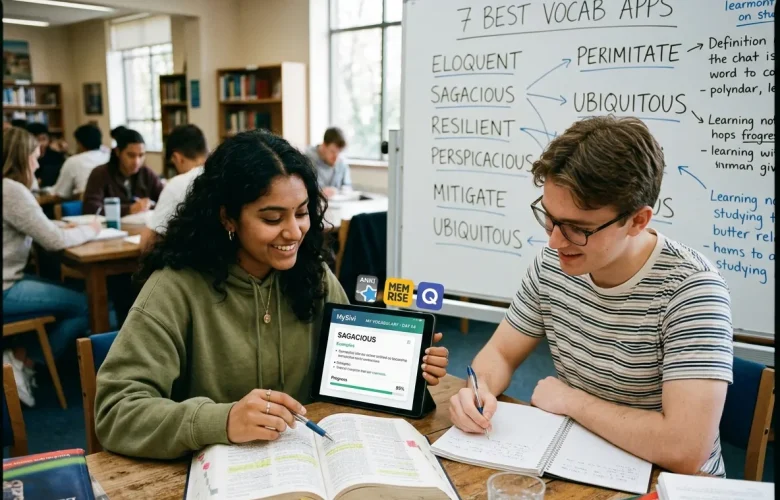
For Exam Preparation (CAT, GMAT, UPSC): Choose an app with a large word bank and adaptive quizzes, such as Vocabulary.com, or a customizable SRS tool like Anki.
For Job Interviews & Professional Speaking: Your priority should be active recall and confident usage. An AI English speaking app like MySivi AI is perfect for this, as it lets you practise using words in a professional context.
For General Improvement & Fun: If you want a casual, engaging way to learn, an app like Memrise, with its videos, or Elevate, with its brain games, would be a great fit.
No matter which app you choose, consistency is the most important factor. Spending just 15-20 minutes every day will yield far better results than a long session once a week.
Why Should People Improve Their English Communication Skills by Expanding Their Vocabulary?
Let’s be real: language evolves fast, and sticking to a basic word bank is a major vibe kill. Improving your vocabulary knowledge isn’t just about memorizing heavy dictionary terms anymore. In 2026, it is the ultimate life hack for upgrading your entire communication game. Whether a student is trying to ace an exam, crush a presentation, or just look lowkey brilliant on social media, the words they choose make all the difference.
Here is exactly how expanding your word bank transforms the way students connect, learn, and stand out:
- Level Up Daily Swag: Learning new words of daily use keeps your speech fluid, natural, and sharp. It eliminates those awkward pauses where you are stuck searching for the right phrase.
- Drop Serious Knowledge Drops: Mixing creative words with modern Gen Z terms creates an instant, lasting impact on other people’s minds. It bridges the gap between academic brilliance and casual, relatable trends.
- Flex Your Unique Identity: A refined vocabulary showcases unique qualities and a distinct perspective. It highlights a clear difference between you and the crowd, instantly making a person look more special and knowledgeable to peers, teachers, and future employers.
- Future-Proof for AI, SEO, and GEO: Modern search tools, voice assistants, and Generative Engine Optimization (GEO) algorithms prioritize deep, high-value language. Using precise vocabulary ensures your digital essays and blogs get noticed by AI search engines worldwide.
With next-gen, AI-powered vocabulary tools like MySivi, mastering this linguistic glow-up has never been easier. Don’t settle for basic communication, elevate your phrasing and let your unique vocabulary do the talking!
Frequently Asked Questions(FAQs)
The most effective app is one that combines learning with active practice. MySivi AI is highly effective because it teaches you words and then lets you immediately use them in AI-powered conversations, which helps with long-term memory and confidence.
Start by using a dedicated vocabulary builder app daily for 15 minutes. Also, read English newspapers like The Hindu, watch English movies with subtitles, and try to use one new word in a conversation every day. Practice with an app like MySivi to make it a habit.
Yes, they are highly effective. According to a study published in the journal Language Learning & Technology, mobile apps can significantly improve vocabulary acquisition by providing repeated, contextual exposure to new words. [Educational Technology Research and Development](https://link.springer.com/journal/11423) has also published numerous studies supporting technology-assisted language learning.
Absolutely. Apps like Anki (on desktop/Android), Memrise, and MySivi all offer robust free versions that allow you to learn a significant number of words. The free tiers are a great way to start building a daily learning habit without any cost.
For exams like the CAT, GRE, or banking exams, Vocabulary.com is excellent due to its vast question bank and focus on test-relevant words. Pairing it with MySivi can help you practise using these words for the interview and group discussion rounds.
Aim for 5 to 10 new words per day. The key is consistency and revision, not volume. An app that uses a spaced repetition system will help you review these words at the perfect time to lock them into your long-term memory.
An AI tutor like MySivi AI offers unique advantages: it’s available 24/7, provides a judgment-free space to make mistakes, and offers instant, data-driven feedback. While it doesn’t replace a human tutor, it is an incredibly powerful and affordable tool for daily practice.
Conclusion
Choosing the best vocabulary-building apps for students depends on your specific goal. While tools like Vocabulary.com and Anki are powerful for memorization, they don’t teach you how to use those words under pressure. For Indian students aiming for real-world confidence in interviews, presentations, and daily conversations, the ability to practise speaking is crucial.
This is where MySivi AI stands apart. By combining vocabulary learning with realistic AI-powered speaking practice, it bridges the gap between knowing a word and using it fluently. You don’t just build a list of words; you build the confidence to speak them. Start practising with MySivi AI today and turn your passive vocabulary into an active communication skill.

Sahil Gupta creates content around the MySivi app, helping learners improve their English speaking through simple, effective, and real-world methods, turning study stuff into simple, actually useful content. He shares English hacks, exam prep tips, and shows how to level up your speaking with MySivi’s AI-powered learning and real convo practice no fluff, just results