
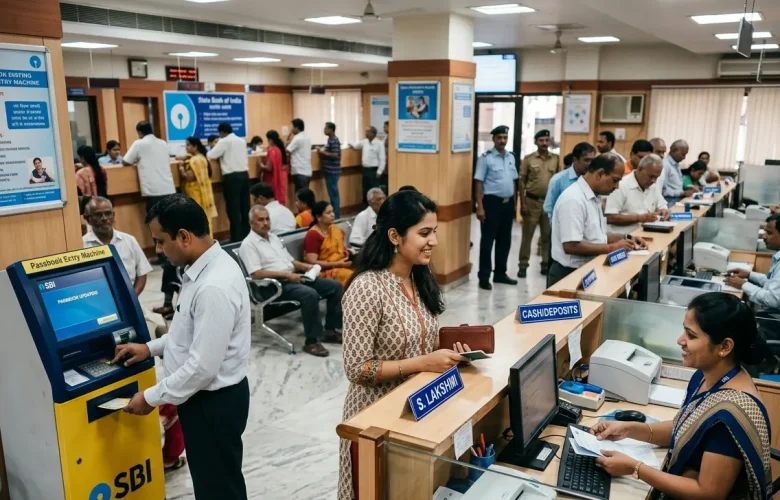
Feeling nervous at the bank? Learn key English phrases, vocabulary, and conversations for all banking needs in India. Start speaking confidently today.
Do you ever feel a little lost when the bank teller asks you something in English? You know what you want to do- deposit money, ask for a statement, or open an account- but finding the exact English words feels like a challenge. That moment of hesitation is common, but it doesn’t have to be your reality.
This guide will give you the precise English you need at the bank, from basic vocabulary to full conversations. We’ll cover everything you need to handle any task with confidence, so your next bank visit is smooth and stress-free.
Quick Answer
To speak English confidently at a bank, learn key phrases for your specific task, such as “I would like to deposit some cash” or “Could you please update my passbook?” Also, understand basic banking English vocabulary like ‘account holder,’ ‘debit,’ ‘credit,’ and ‘beneficiary’ to follow conversations easily.
Key Takeaways
Master Core Vocabulary: Learn essential terms for accounts, transactions, and people at the bank.
Use Simple Phrases: Prepare specific sentences for common tasks like depositing money, withdrawing cash, and checking your balance.
Practise Common Dialogues: Role-playing conversations, like opening an account or reporting a lost card, builds confidence.
Understand Digital Banking Terms: Familiarise yourself with English for mobile and internet banking, including terms like ‘OTP’, ‘beneficiary’, and ‘transaction ID’.
Practise with AI: Use an AI English teacher like MySivi AI to practice these conversations aloud and get instant feedback before your visit.
Essential Banking English Vocabulary for Beginners
Before you can build sentences, you need the right words. Many banking terms can be confusing. Here is a simple breakdown of the most common banking terms in English, with their Hindi meanings to help you connect the concepts.
Learn these common English banking terms with Hindi meanings to communicate confidently at a bank, understand financial transactions, and improve your everyday banking vocabulary.
English Banking Term | Simple Meaning in English | Hindi Meaning | Example Sentence in English |
Account Holder | A person who owns a bank account. | खाताधारक (Khaatadharak) | I am the account holder of this savings account. |
Savings Account | A bank account used to save money and earn interest. | बचत खाता (Bachat Khata) | I deposit a part of my salary into my savings account. |
Current Account | A bank account mainly used by businesses for frequent transactions. | चालू खाता (Chalu Khata) | Our company uses a current account for daily payments. |
Debit | An amount deducted from your bank account. | नामे / खाते से कटौती (Naame / Khate Se Katauti) | The bank debited ₹500 from my account. |
Credit | An amount added to your bank account. | जमा / खाते में राशि जुड़ना (Jama / Khate Mein Rashi Judna) | My salary was credited to my bank account. |
Withdrawal | The act of taking money out of a bank account. | निकासी (Nikaasi) | I would like to make a cash withdrawal. |
Deposit | The act of putting money into a bank account. | जमा करना (Jama Karna) | I want to deposit ₹2,000 into my account. |
Beneficiary | A person who receives money transferred by someone else. | लाभार्थी (Laabharthi) | I added my brother as a beneficiary for online transfers. |
Transaction | Any banking activity, such as depositing, withdrawing, or transferring money. | लेन-देन (Len-Den) | Please check whether my transaction was successful. |
Interest Rate | The percentage used to calculate interest earned or paid on money. | ब्याज दर (Byaaj Dar) | What is the current interest rate on this savings account? |
Passbook | A bank-issued booklet that records account transactions. | पासबुक (Passbook) | Could you please update my passbook? |
Cheque | A written instruction asking a bank to pay a specified amount to someone. | चेक (Cheque) | I issued a cheque to pay my school fees. |
How to Speak English at the Bank: Phrases for Every Task
Knowing what to say makes all the difference. Here are the exact English phrases used at the bank for the most common situations you’ll face in India.
- English for Opening a Bank Account
This is often the first step. You need to ask for the right form and understand the requirements.
* “I would like to open a savings account.”
* “Could you please tell me the procedure for opening a new account?”
* “What documents are required for KYC verification?” (KYC stands for ‘Know Your Customer’ and is a mandatory verification process regulated by the [Reserve Bank of India](https://www.rbi.org.in/Scripts/FAQView.aspx?Id=123)).
* “Is there a minimum balance I need to maintain?”
* “I have filled out the English bank account opening form. Could you please check it?”
- English for Depositing and Withdrawing Money
These are daily transactions. Being clear and direct helps avoid mistakes.
Phrases for Depositing Money:
* “I want to deposit some cash into my account.”
* “Here is the deposit slip and the cash.”
* “Could I deposit this cheque, please?” (English for cheque deposits)
* “Please credit this amount to my account number…”
Phrases for Withdrawing Money:
* “I need to withdraw ₹5,000.”
* “I would like to make a withdrawal.”
* “Can I withdraw money using this withdrawal slip?”
- English for Asking About Your Bank Balance
Sometimes you just need to know where you stand financially.
* “Could you please tell me my account balance?”
* “I’d like to check the balance in my account.”
* “Can I get a mini-statement for my account?”
- English for Other Common Bank Visits
From updating details to applying for cards, here are the sentences you’ll need.
Updating Details: “I need to update my mobile number/address linked to my account.”
Applying for a Card: “I would like to apply for a new debit card.” (English for applying for a debit card)
Reporting a Lost Card: “I have lost my debit card. I need to block it immediately.”
Passbook Updates: “Could you please update my passbook?”
Bank Conversation in English: A Sample Dialogue

Let’s see how these phrases work in a real situation. Here is a sample English dialogue between a customer and a bank teller.
Customer: “Good morning. I would like to deposit this cheque into my savings account.”
Teller: “Good morning. Certainly. Have you filled out the deposit slip?”
Customer: “Yes, here it is, along with the cheque and my passbook.”
Teller: “Thank you. Let me check… Everything seems to be in order. The amount is ₹10,000. It will be credited to your account by the end of the day.”
Customer: “Great. Also, could you please update my passbook?”
Teller: “Of course. Just one moment… Here you are. It’s all updated.”
Customer: “Thank you for your help!”
This simple exchange uses clear, direct language. But what if you’re not sure how you sound? Practicing these real-life English conversations at the bank beforehand is the key to confidence.
Beyond the Counter: 3 Scripted Scenarios to Master Tele-Banking and Financial Advice
Modern banking in India doesn’t just happen at the branch counter; it happens over phone calls, customer support chats, and across the desks of financial advisors. To be truly fluent, you need to navigate these unique conversations without hesitation.
Below are three realistic, detailed scripts designed to help you practice targeted vocabulary for phone banking, customer support, and wealth management.
Scenario 1: The Outbound Sales Call (Handling Phone Banking Offers)
Context: A bank sales executive calls you to pitch a pre-approved credit card or loan product.
- Sales Executive: “Good afternoon, I am calling from YourBank’s credit card division. Am I speaking with the account holder?”
- You: “Yes, speaking. How can I help you?”
- Sales Executive: “Sir/Ma’am, congratulations! Based on your healthy transaction history, you are eligible for a pre-approved, lifetime-free credit card with a premium reward points program.”
- You: “Thank you for the offer. Could you please email me the detailed terms and conditions? Specifically, I want to check the annual percentage rate (APR) and if there are any hidden joining fees.”
- Sales Executive: “Certainly, I will share the product brochure on your registered email ID immediately.”
Scenario 2: The Urgent Customer Support Call (Reporting Discrepancies)
Context: You notice an unauthorized deduction on your mobile banking app and call the 24/7 customer care helpline to raise a dispute.
- Customer Support: “Welcome to YourBank Customer Care. My name is Rahul. How may I assist you today?”
- You: “Hi Rahul, I need to report an unauthorized transaction. I just received an SMS stating that ₹5,000 was debited from my account, but I did not initiate this payment.”
- Customer Support: “I understand your concern, and I can help you with that. For security purposes, can you verify your full name and date of birth?”
- You: “Yes, my name is [Your Name], and my DOB is [Your DOB]. Please block my debit card immediately and generate a dispute transaction ID for this deduction.”
- Customer Support: “I have successfully blocked your card to prevent further misuse. Your dispute ticket number is txn-98765. We will investigate this chargeback request within 7 working days.”
Scenario 3: Sitting Down with a Bank Financial Advisor (Wealth Management)
Context: You want to invest your savings into smarter financial instruments rather than keeping it all in a low-interest savings account.
- Financial Advisor: “Good morning. I see you want to discuss investment avenues today. What are your primary financial goals?”
- You: “Good morning. I am looking to beat inflation. Currently, my funds are sitting idle in my savings account earning low interest. I want to know about better investment options.”
- Financial Advisor: “We can look at a mix of Mutual Funds through a Systematic Investment Plan (SIP) or tax-saving Fixed Deposits (FDs), depending on your risk appetite.”
- You: “I prefer a moderate-risk portfolio. Can you explain the lock-in period for the tax-saving schemes, and what the expected historical returns have been?”
- Financial Advisor: “Tax-saving fixed deposits have a mandatory 5-year lock-in period, whereas certain equity-linked mutual funds have a 3-year lock-in but offer potentially higher yields.”
The Best Way to Practice Spoken English at the Bank
Reading phrases is a good start, but speaking them aloud is what builds fluency. This is where an AI-powered tool can be your best friend.
The MySivi English speaking app is designed for exactly this. You can practise these specific banking scenarios with MySivi AI, your personal AI English teacher.
Key Features That Make MySivi AI Stand Out:
Realistic Role-Play: Choose scenarios like “At the Bank” or “Applying for a Loan” and have a full conversation with the AI. It feels like a real dialogue.
Instant Feedback: MySivi AI listens to you and gives immediate feedback on your pronunciation, grammar, and sentence structure. It will tell you if you said “deposite” instead of “deposit.”
Practice Anytime: Feel nervous practising with a person? Your AI tutor is available 24/7 with zero judgement. You can repeat the conversation as many times as you need.
Vocabulary Tracking: The app helps you build your banking vocabulary for beginners by tracking the new words you use correctly.
Using MySivi is like having a practice session before your actual bank visit, so when you get to the counter, the words come out naturally. As the best English-speaking app for targeted practice, it closes the gap between knowing the words and using them confidently.
Frequently Asked Questions(FAQs)
To learn quickly, focus on the vocabulary and phrases most relevant to you. Start with your most common task, like depositing money. Practice those specific sentences daily using an app like the MySivi English speaking app for speaking practice.
Some useful sentences include: “I would like to open a savings account,” “I need to deposit ₹2,000,” “Could you please check my account balance?” and “I want to apply for a debit card.”
Improve by practicing real conversations. Use an AI English teacher to simulate dialogues with a bank teller. This helps you practise your listening and speaking skills in a realistic, pressure-free environment.
The best way is through active role-playing. You can write down a script and practice with a friend, or use an AI tool like MySivi AI, which provides interactive scenarios specifically for banking conversations.
Absolutely. Bank staff are used to dealing with many people. Using simple, clear English is more effective than trying to use complex sentences. For example, saying “I need to withdraw cash” is perfect.
It’s perfectly fine to ask for clarification. You can say, “Sorry, I didn’t understand. Could you please repeat that?” or “Could you explain what that means?” Honesty is better than guessing.
This article provides a great starting point. For interactive practice, an AI English speaking app is an excellent resource, as it can generate numerous examples and conversations for you to participate in.
Conclusion
Navigating a bank in English doesn’t have to be intimidating. By learning a few key phrases and understanding basic vocabulary, you can handle any transaction smoothly. Remember to start with the essentials, use simple sentences, and don’t be afraid to ask for clarification. The key is to turn knowledge into a spoken skill. Start practicing with MySivi AI today and walk into your next bank visit with complete confidence.

Sahil Gupta creates content around the MySivi app, helping learners improve their English speaking through simple, effective, and real-world methods, turning study stuff into simple, actually useful content. He shares English hacks, exam prep tips, and shows how to level up your speaking with MySivi’s AI-powered learning and real convo practice no fluff, just results

