

No partner? No problem. Try 12 fun, proven ways to practice English speaking at home alone, plus how AI like MySivi gives instant feedback.
You know your tenses. You’ve memorised vocabulary lists. Then someone says, “So, tell me about yourself,” and your brain buffers like a 2G connection.
If that’s you, you’re not alone. Millions of learners in India know English but freeze while speaking it. The real problem is usually not knowledge but practice, and finding a partner who is free, patient, and won’t judge you is hard.
Good news: you don’t need one. A partner isn’t necessary for conversation. Multiple AI English Tutors are already in the commercial market, and millions of non-native speakers are using them daily. Today’s advanced, hyper-realistic voice models let you ditch the traditional chatbot and have real-time, fluid conversations with specialized English-learning apps. From free AI language tools to premium virtual coaching platforms, the modern EdTech ecosystem provides instantaneous pronunciation feedback, grammar corrections, and contextual vocabulary upgrades without the anxiety of human judgment. This guide covers English speaking practice at home without a partner, using simple techniques, a bit of self-talk comedy, and smart AI tools. You’ll build real confidence, starting today.
Quick Answer
To practice spoken English at home without a partner, spend 15-20 minutes daily on shadowing, thinking aloud in English, and recording your voice to catch mistakes. For instant feedback and realistic conversations, an AI English-speaking app like MySivi is the fastest way to improve.
Key Takeaways
- Consistency beats intensity. 15 minutes daily wins over a 3-hour session once a month.
- Speak, don’t just consume. Watching 50 English reels doesn’t count as speaking. Your mouth needs reps too.
- AI is your judgement-free partner. It never gets tired, never laughs at you and never leaves you on “seen.”
- Self-talk builds fluency. Narrating your day trains your brain to think in English.
- Aim for fluent, not flawless. Clear communication is the goal. A perfect accent is optional.
Which Method Is Right for You? (Quick Comparison)
Method | Time Needed | Difficulty | Best For |
AI tutor (MySivi) | 15 min | Easy | Feedback and real conversations |
Shadowing | 10 min | Medium | Accent, rhythm, intonation |
Self-talk | 5-10 min | Easy | Thinking in English |
Voice recording | 5 min | Medium | Spotting your own mistakes |
Reading aloud | 10-15 min | Easy | Pronunciation and flow |
Phrase of the day | 5 min | Easy | Sounding natural |
Mirror practice | 5 min | Easy | Confidence and body language |
Movie scenes | 10 min | Easy | Fun plus real-life dialogue |
Describing surroundings | 5 min | Easy | Vocabulary on the spot |
Singing along | 5-10 min | Easy | Rhythm and connected speech |
Situation prep | 10 min | Medium | Interviews and presentations |
30-day challenge | 15-30 min | Medium | Building a habit |
How Can I Practice English Speaking at Home Without a Partner?
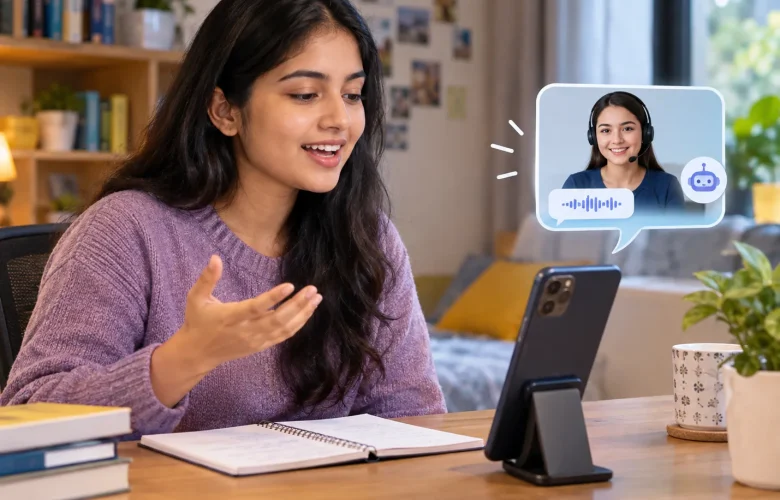
Finding a speaking partner is tough: schedules clash, friends are busy, and let’s be honest, nobody wants to make mistakes in front of Sharma ji’s son.
The fix is to build your own practice zone at home. Research on mobile-assisted language learning suggests that learning apps can help improve speaking skills, which makes solo practice more effective than ever. Here are 12 methods you can start right now.
1. Talk to Your Personal AI English Tutor
Solo practice has one big flaw: no feedback. How do you know your pronunciation is right or that your sentence sounds natural? This is where AI steps in.
An English-speaking practice with AI app like MySivi works as your personal tutor, available 24/7. No awkward silences, no judgment, and no “bro, what did you just say?” Just speak.
What makes MySivi AI stand out:
Feature | What It Does | Why You’ll Love It |
Topic-Based AI Calls | Practice job interviews, ordering food, travel plans, and more | Real-life situations, zero embarrassment |
Instant, Detailed Feedback | Analyses grammar, pronunciation, and sentence structure after every call | Like a teacher’s red pen, but kinder |
Personalised Learning | Remembers your past performance and targets your weak spots | It learns you, like a bestie who knows your patterns |
Live Group Practice | Join topic-based group calls with other learners | Level up when you’re ready |
2. Use the Shadowing Technique
The shadowing technique for English speaking is simple but powerful for improving accent, rhythm, and intonation.
- How it works: Pick a short audio or video clip of a native speaker. Listen to one sentence, then repeat it right away, copying the speed, tone, and pronunciation.
- Pro tip: Start with 2-3 minute clips from TED Talks or news reports. Don’t stress about understanding every word. Focus on the sound, like you’re copying a song you love.
Think of it as being the speaker’s echo. Main character energy, but you’re the backup vocals.
3. Think and Talk to Yourself in English
One of the best ways to speak English without a partner is to turn your inner monologue into English. This is English self-talk practice.
- How to start: Narrate your everyday actions. “I’m walking to the kitchen. I’m going to make chai. First, I need to boil the water.”
- Make it fun: Narrate like a cricket commentator. “And here comes our hero, approaching the fridge… will he choose the leftover biryani? Oh, what a shot! The biryani is OUT of the fridge!”
- Why it works: Your brain has to build sentences and find words on the spot, exactly what happens in a real conversation. This is the shortcut to learning how to speak English naturally.
4. Record Your Voice and Listen Back
We rarely notice our own small mistakes. Recording yourself works like a mirror for your spoken English. Yes, hearing your own voice feels cringe at first, but that’s where the growth is.
- The process: Pick a topic and speak for 1-2 minutes. Read a paragraph or answer a question like “What did you do yesterday?”
- What to check: Pronunciation slips, filler words and speaking speed. This is a key step in learning how to stop hesitating while speaking English.
Filler word detox:
If You Say Too Much… | Try This Instead |
“Umm… ahh… like…” | A calm 1-second pause. Silence sounds confident. |
“Basically… actually…” (every sentence) | Use once per answer, max |
“You know, you know…” | “Let me put it this way…” |
5. Read Aloud Daily
Reading aloud connects the written word to the spoken word. It trains your mouth to form English sounds and builds muscle memory, like a gym session for your tongue.
- What to read: News articles, short stories, even children’s books. No shame, they’re great.
- Daily goal: 10-15 minutes as part of your daily English speaking practice routine.
6. Learn and Use One New Phrase a Day
Single words are good, but phrases make you sound fluent. Learn one a day and use it before bedtime.
Phrase | Meaning in Hindi | Example Sentence |
Break a leg | शुभकामनाएँ | “You have an exam tomorrow? Break a leg!” |
Bite the bullet | हिम्मत से काम लेना | “I had to bite the bullet and tell my boss the truth.” |
On the ball | चौकन्ना रहना | “Our project manager is always on the ball.” |
Spill the tea | राज़ की बात बताना | “Come on, spill the tea! What happened at the party?” |
It’s giving… | ऐसा लग रहा है… (वाइब) | “That outfit? It’s giving main character energy.” |
7. Use a Mirror to Practice
Speaking in front of a mirror shows your mouth movements, expressions, and body language. It builds confidence and is a great way to learn English without a teacher.
Try giving a mini speech like it’s your award-winning moment. Bonus points for dramatic hand gestures.
8. Watch Movies and TV Shows with a Purpose
Don’t just binge. Study.
- Step 1: Watch a short scene with English subtitles.
- Step 2: Pick a few lines you like.
- Step 3: Pause and repeat them aloud, matching the actor’s delivery.
It’s a fun way to do English practice without a partner, and it beats scrolling for the 47th time.
9. Describe Your Surroundings
Another simple self-talk exercise. Look around and describe what you see in English, in as much detail as you can.
“I’m sitting at my wooden desk. On it, there’s a black laptop, a blue notebook, and a silver pen. The window is on my left, and I can see trees outside.”
Level up: describe your room like a real estate agent. “This charming, slightly messy workspace offers a stunning view of… the neighbour’s laundry.”
10. Sing Along to English Songs
Singing improves rhythm and flow because you naturally link words together, a key part of fluent speech. Pick your favourite English songs and sing along while reading the lyrics. Your shower now has a talent show.
11. Prepare for Specific Situations
Want to improve your English speaking skills for an interview or presentation? Practise that exact scenario. Write down likely questions and answer them aloud. The more you rehearse, the less your heart races on the big day.
Situation | Practice This |
Job interview | “Tell me about yourself.” / “What are your strengths?” |
Office meeting | “I’d like to add a point here…” |
Making friends | “So, what do you do for fun?” |
Ordering at a café | “Could I get a cappuccino with less sugar, please?” |
12. Create a 30-Day Challenge
To improve English speaking at home in 30 days, you need a plan, not just good vibes. Here’s a simple one:
Week | Focus | Daily Time |
Week 1 | Shadowing and reading aloud | 15 min |
Week 2 | Add self-talk and voice recording | 20 min |
Week 3 | Start AI conversations on MySivi, continue self-talk | 15 min + self-talk |
Week 4 | Situation-specific practice on MySivi, review your recordings | 20-30 min |
Tick off each day on a calendar. Seeing that streak grow is low-key addictive.
Common Mistakes Solo Learners Make (And Quick Fixes)
❌ Mistake | ✅ Fix |
Only watching or listening, never speaking | Speak aloud for at least 10 minutes daily |
Waiting to be “perfect” before speaking | Speak first, polish later |
Practising once a week for 2 hours | Practise daily for 15 minutes |
Never checking your errors | Record yourself or use an AI tutor |
Quitting after 3 days | Use the 30-day challenge and track your streak |
Frequently Asked Questions(FAQs)
Use the shadowing technique, talk to yourself about your day in English, and record your voice to find mistakes. For interactive practice, an AI app like MySivi gives you a conversation partner on demand.
MySivi is a strong choice. It offers AI conversation partners for different scenarios, instant feedback on grammar and pronunciation, and progress tracking, all in one place.
Practice daily. Aim for about 30 minutes a day: 10 minutes of shadowing, 10 minutes of self-talk, and a 10-minute conversation with an English-speaking AI like MySivi. Consistency matters most. (If you’re short on time, even 15-20 minutes a day works.)
Yes, especially for speaking. Self-learning resources and AI tutors like MySivi provide the structure, practice, and feedback that once came only from a human teacher.
Yes. Talking to yourself in English daily helps you build sentences, recall vocabulary faster, and make thinking in English a habit, which is a cornerstone of fluency.
Conclusion
You don’t need a speaking partner to become a fluent, confident English speaker. Shadowing, self-talk, and recording yourself can take you far on your own. But for the fastest progress, add technology. An AI tutor gives you what solo practice can’t: unlimited conversation with instant, personalised feedback.
Ready to stop hesitating and start speaking? Download the MySivi AI English speaking app and have your first conversation in the next five minutes. Your future fluent self is already proud.

Sahil Gupta creates content around the MySivi app, helping learners improve their English speaking through simple, effective, and real-world methods, turning study stuff into simple, actually useful content. He shares English hacks, exam prep tips, and shows how to level up your speaking with MySivi’s AI-powered learning and real convo practice no fluff, just results