Discover the best YouTube channels to learn English in 2026. Improve pronunciation, vocabulary, fluency, and confidence with practical tips and MySivi.
Have you ever watched an entire English podcast, understood every third word, and still replied to your friend with “Yes, bro, same”? Congratulations. You have officially entered the I-can-understand-English-but-can’t-speak-it club.
The good news? You don’t need to move to London, hire a private tutor, or suddenly become the main character in an American sitcom to improve your English.
Sometimes, the best classroom is already sitting in your pocket: YouTube.
The platform offers thousands of free videos covering English pronunciation, grammar, vocabulary, everyday conversations, accents, storytelling, psychology, and personal development. Whether you’re a student preparing for interviews, a professional trying to sound more confident in meetings, or someone who wants to stop translating every sentence in their head, there’s a channel for you.
But here’s the catch: watching English content and speaking English confidently are two different skills. You can binge-watch 50 videos about pronunciation and still panic when someone asks, “Could you introduce yourself?”
That’s why this guide goes beyond a typical list of English teachers. We’ve grouped some of the best YouTube channels to learn English by learning goals, from mastering pronunciation and understanding native speakers to building better habits, expanding your worldview, and practising real conversations.
You’ll also discover how to turn your favourite videos into an everyday English-speaking routine using a simple method: Watch, Shadow, Speak.
Let’s find your next favourite channel.
Quick Answer: Which YouTube Channels Are Best for Learning English?
The best YouTube channel depends on what you want to improve. Here are some useful starting points:
Your learning goal | Recommended YouTube channel |
Practicing English after watching lessons | |
British English and vocabulary | |
English lessons explained in Hindi | |
Short lessons and listening practice | |
Natural American conversations | |
Everyday vocabulary | |
English through movies and TV shows | |
Learning mindset and motivation | |
Productivity and personal development | |
American English pronunciation |
Our recommendation: Choose two or three channels that complement each other. For example, practice English speaking using MySivi, learn pronunciation from Rachel’s English, build listening skills with BBC Learning English, and then practice speaking using the expressions you’ve learned.
You don’t need 20 subscriptions. You need a learning routine you can actually stick to.
Best YouTube Channels for English Pronunciation, Vocabulary and Fluency
If your goal is to speak English more clearly, understand native speakers, and express yourself naturally, start with channels that teach the language in context.
1. Rachel’s English — Master American English Pronunciation
Best for: Pronunciation, connected speech, accent awareness, and speaking clarity.
Recommended level: Beginner to advanced, depending on the lesson.
Watch Rachel’s English on YouTube
Ever wondered why native English speakers seem to swallow half their words and still expect everyone to understand them?
Welcome to connected speech.
Rachel’s English breaks down American English pronunciation into manageable lessons. You’ll find explanations of mouth position, vowel and consonant sounds, word stress, rhythm, intonation, and the way words blend during everyday conversations.
Instead of simply memorising how a word is spelt, you can observe how it’s pronounced and practice producing the sound yourself.
Try this: Pick a short pronunciation lesson. Listen to one sentence, pause the video, and repeat it three times. Pay attention to the stress and rhythm rather than copying individual sounds alone.
Gen Z example: Your textbook might teach you every letter in a sentence. Real-life English might connect those words so smoothly that your brain goes, “Wait, did they say one word or seven?”
Rachel’s lessons can help you understand what’s happening.
2. English with Lucy — Sound More Natural in British English
Best for: British pronunciation, vocabulary, idioms, grammar, and polished communication.
Recommended level: Beginner to advanced, depending on the topic.
Watch English with Lucy on YouTube
Want to understand British expressions without feeling as though you’ve accidentally walked into a period drama?
English with Lucy makes British English approachable through structured lessons covering vocabulary, pronunciation, common mistakes, grammar, and natural expressions.
Her content is especially useful for learners who want to expand their vocabulary and understand the differences between textbook English and the way people communicate in everyday situations.
For example, knowing the word “tired” is useful. Learning expressions such as “I’m exhausted,” “I’m worn out,” and “I’m knackered” helps you recognize different levels of emphasis and informal British usage.
Try this: Write down three new expressions from a lesson and create a sentence about your own life using each one.
The goal isn’t to use fancy vocabulary in every sentence. It’s to have more ways to express the same idea.
3. Learnex — English Lessons Through Hindi
Best for: Hindi-speaking beginners who want clear explanations of English concepts.
Recommended level: Beginner to intermediate.
Sometimes, the problem isn’t that English grammar is impossible. It’s that the explanation is more confusing than the grammar itself.
Learnex offers English lessons through Hindi, helping learners understand grammar rules, vocabulary, common errors, and everyday English expressions.
For learners in India who are more comfortable understanding a concept in Hindi before applying it in English, this bilingual approach can make the learning process less intimidating.
For instance, instead of memorising a tense formula without understanding it, learn when to use the tense and practise creating sentences about your daily routine.
Try this: Learn one grammar rule, write five original sentences, and read them aloud without translating each word separately.
A gentle reminder: Hindi can be a useful starting point, but gradually try forming simple thoughts directly in English. Your brain doesn’t need to hold a translation meeting before every sentence.
4. BBC Learning English — Build a Consistent Learning Habit
Best for: Listening, grammar, vocabulary, news-related English, and short daily lessons.
Recommended level: Beginner to advanced, depending on the series.
Watch BBC Learning English on YouTube
If you struggle to find time for English practice between college, work, commuting, and scrolling through reels, BBC Learning English is worth exploring.
Its educational content includes short lessons, vocabulary explanations, pronunciation guidance, and discussions of current topics. Series such as 6 Minute English offer a convenient way to practise listening in manageable sessions.
You can also learn expressions used in news reporting, professional communication, and everyday conversation.
Try this: Watch one short video during breakfast. Write down two useful expressions and summarize the topic aloud in three sentences.
You don’t need to turn every morning into an IELTS examination. Six focused minutes can be a practical starting point.
5. Speak English With Vanessa — Practise Natural Everyday English
Best for: Conversational English, listening, common expressions, and speaking confidence.
Recommended level: Beginner to intermediate, with lessons suitable for different abilities.
Watch Speak English With Vanessa on YouTube
You may know the grammar rules perfectly and still struggle when someone asks, “So, what did you do over the weekend?”
This is where conversational English becomes important.
Vanessa’s channel focuses on practical expressions, everyday conversations, listening, and the natural patterns people use when speaking English. Her friendly teaching style makes it useful for learners who want to move beyond memorized textbook dialogues.
For example, instead of replying “I am fine” to every greeting, you can practice expressions such as:
- “I’m doing pretty well, thanks!”
- “It’s been a busy week.”
- “Can’t complain!”
- “I’m hanging in there.”
Try this: Pause after a model sentence and answer the same question using your own information. Don’t just repeat the example—make it yours.
6. Learn English with Bob the Canadian — Learn Vocabulary from Everyday Life
Best for: Practical vocabulary, everyday situations, and understanding English in context.
Recommended level: Beginner to intermediate.
Find Bob the Canadian on YouTube
You don’t learn a language only by studying definitions. You learn it by connecting words with situations.
Bob the Canadian teaches English through familiar subjects and real-world contexts, making his videos useful for learners who want to understand the vocabulary used in daily life.
Think shopping, travel, work, household objects, and ordinary interactions. These are precisely the situations where knowing the right expression can make communication easier.
For example, learning “Could you give me a moment?” is useful when you need time to think during a conversation.
Try this: Pick five objects around you and describe each one in English. Then explain what you did today without writing a script first.
It’s simple, practical, and surprisingly effective as a speaking exercise.
7. EnglishClass101 — Explore English Lessons for Different Levels
Best for: Topic-based learning, vocabulary, grammar, listening, and structured lesson exploration.
Recommended level: Beginner to advanced, depending on the video.
Watch EnglishClass101 on YouTube
Some days, you need help with pronunciation. Other days, you need to understand a common phrase or practise a particular conversation.
EnglishClass101 provides a broad collection of English-learning videos that you can explore according to your interests and current level.
This variety is helpful when you want to build a personal study routine rather than follow only one type of lesson.
Try this: Choose one specific topic, such as introducing yourself, ordering food, or preparing for a job interview. Learn the expressions, then create a short dialogue using them.
Avoid opening ten unrelated lessons in one sitting. Your watch history might look productive, but your brain deserves a syllabus.
8. Learn English with TV Series — Learn from Movies and Shows
Best for: Listening comprehension, idioms, informal English, and understanding natural speech.
Recommended level: Intermediate to advanced, with some accessible lessons for beginners.
Watch Learn English with TV Series on YouTube
What if your next English lesson felt more like watching your favourite show than sitting through a grammar lecture?
Learn English with TV Series breaks down scenes from popular entertainment, helping learners understand expressions, pronunciation, vocabulary, humour, and cultural references.
This can be especially useful because real conversations often sound different from carefully prepared classroom dialogues. People speak quickly, connect words, use idioms, and occasionally mumble.
Try this: Select a short scene. Watch it once for the overall meaning, then replay it with subtitles. Write down three expressions and imitate one complete line.
For example, if a character says, “You have got to be kidding me,” practise the entire expression instead of memorizing only the word “kidding.”
Gen Z translation: Your favourite sitcom can become an English lesson. Just don’t claim you’re studying English when you’ve watched six episodes and learned only the word “literally.”
9. Pronunciation with Emma — Improve Your British English Clarity
Best for: British pronunciation, grammar explanations, and targeted language difficulties.
Recommended level: Beginner to advanced, depending on the lesson.
Find Emma’s lessons on YouTube
If you frequently confuse similar-sounding words or struggle with particular pronunciation patterns, focused lessons can be more useful than general English videos.
Emma’s lessons through engVid cover practical English topics, including pronunciation and grammar. Look for the specific lesson that matches your difficulty rather than watching videos randomly.
For example, compare words such as “ship” and “sheep.” The difference between their vowel sounds can change the meaning completely.
Try this: Listen to the target sound, repeat it slowly, and then practice it inside a complete sentence. Record yourself and compare your pronunciation with the model.
Remember, the aim is clear communication—not trying to erase your identity or imitate an accent perfectly.
10. English with Yuliya — Practice English Shadowing
Best for: Learners seeking focused listening, pronunciation, and fluency exercises.
Recommended level: Intermediate learners and above, depending on the lesson.
Find English with Yuliya on YouTube
Shadowing is a language-learning technique in which you listen to a speaker and repeat their words almost simultaneously, paying attention to rhythm, stress, and intonation.
English with Yuliya is worth exploring if you want to incorporate this style of practice into your routine. Review individual videos to find exercises and materials that suit your current level.
Try this: Choose a 20–30-second clip. Listen once, replay it while speaking along, and repeat the exercise several times.
Don’t worry if you sound awkward at first. Your first attempt at shadowing might sound like your brain and your mouth are working different shifts. That’s normal.
Best YouTube Channels for Learning English Through Mindset and Motivation
Improving your English isn’t only about learning new words. It also involves understanding how you learn, managing frustration, and staying consistent when progress feels slow.
These channels can help you explore those ideas while giving you more English listening practice.
11. Canguro English — Understand How Language Learning Works
Best for: Language-learning strategies, motivation, and overcoming learning plateaus.
Recommended level: Intermediate and above, depending on the topic.
Watch Canguro English on YouTube
Have you ever studied English consistently for weeks and then felt as if nothing had changed?
Language learning can feel frustrating when you measure progress only by how fluent you sound today.
Canguro English explores the learning process, including motivation, learning strategies, vocabulary acquisition, and the mindset behind language development. Its content encourages learners to think critically about how they study rather than automatically collecting more grammar rules.
Try this: After watching a video, explain its main argument aloud in English. This way, you’re learning about learning while practising your communication skills.
The important lesson is to build a repeatable system rather than constantly search for a magical shortcut.
12. English with Ulle — Make Practice More Interactive
Best for: Learners who enjoy a mix of vocabulary, grammar, pronunciation, humour, and quizzes.
Recommended level: Check individual lessons to find the right starting point.
Find English with Ulle on YouTube
Some people learn best through structured explanations. Others prefer quizzes, humour, and activities that make them participate.
English with Ulle combines different English-learning formats, offering an option for learners who want variety in their practice.
Try this: Before revealing a quiz answer, say your answer aloud and explain why you chose it. This transforms a passive quiz into an opportunity to practise speaking.
After all, watching someone else answer questions is not quite the same as answering them yourself.
Best YouTube Channels for Lifestyle, Productivity and Personal Growth
Want to improve your English while learning about habits, confidence, relationships, or intentional living?
Lifestyle content can provide a refreshing alternative to traditional English lessons. It also exposes you to the language people use when discussing real experiences and personal opinions.
13. Simple Happy Zen — Learn Through Calm, Thoughtful Content
Best for: Minimalism, intentional living, reflection, and relaxed listening practice.
Recommended level: Intermediate learners and above, depending on the video.
Find Simple Happy Zen on YouTube
Not every English-learning session needs to feel like an exam.
Simple Happy Zen explores minimalism, intentional living, and ways to create a calmer, more meaningful lifestyle. Its reflective style can provide an opportunity to listen to thoughtful explanations and encounter vocabulary related to habits, priorities, and well-being.
Try this: Watch a short video and summarise its central idea in your own words. Then share one opinion about the topic.
For example: “I think reducing distractions helps me concentrate better when I’m studying.”
That single sentence practises vocabulary, sentence structure, and expressing an opinion.
14. Lana Blakely — Explore Confidence, Relationships and Life Questions
Best for: Conversational listening, self-reflection, confidence, and personal growth.
Recommended level: Intermediate to advanced.
If you enjoy thoughtful conversations about relationships, self-awareness, confidence, and life choices, Lana Blakely’s content may be a useful addition to your listening routine.
Personal essays and reflective videos expose you to language beyond the standard classroom topics of food, travel, and introductions.
You’ll encounter expressions for describing feelings, explaining experiences, comparing viewpoints, and discussing abstract ideas.
Try this: Write down an expression that helps you describe an emotion or opinion. Use it in a short spoken reflection about your own day.
You don’t need to agree with every idea in a video. Understanding a viewpoint and explaining your own response is excellent communication practice.
15. Matt D’Avella — Improve Your Habits While Practising English
Best for: Productivity, minimalism, habits, focus, and self-improvement.
Recommended level: Intermediate to advanced, depending on the video.
Watch Matt D’Avella on YouTube
Matt D’Avella creates content around habits, productivity, minimalism, and personal development. His videos can help you explore practical ideas while listening to longer explanations in English.
This is especially useful if you want to develop your ability to follow a narrative, understand opinions, and describe cause-and-effect relationships.
Try this: After watching a video about habits, explain one idea you want to apply in your life.
For example: “I’m going to practise English for 15 minutes every day instead of waiting until I have an entire free hour.”
You have now practiced English and created an actionable habit. Two wins, one video.
Best YouTube Channels for Advanced English and Intellectual Growth
If you already understand everyday English, the next challenge is learning to discuss complicated subjects, follow unfamiliar accents, and express nuanced opinions.
These channels offer content that can stretch your vocabulary and listening skills while encouraging critical thinking.
Vox — Learn English Through News, Culture and Explainers
Best for: Current affairs, social issues, history, culture, and advanced vocabulary.
Recommended level: Upper-intermediate to advanced.
Vox explains complex topics through visual storytelling, research-based explainers, and documentary-style videos.
Its content is useful for learners who want to understand discussions about society, technology, politics, culture, and global events.
However, some videos contain dense vocabulary and fast narration, so don’t be discouraged if you need to replay sections.
Try this: Choose a topic you already understand in your first language. Watch a short explainer, identify five unfamiliar expressions, and summarise the main argument aloud.
This helps you practise explaining complex ideas rather than simply repeating memorised sentences.
Jared Henderson — Practise English Through Philosophy
Best for: Critical thinking, philosophy, meaning, and abstract discussions.
Recommended level: Upper-intermediate to advanced.
Find Jared Henderson on YouTube
Philosophical discussions challenge you to follow arguments, consider different perspectives, and explain abstract concepts.
Jared Henderson’s content can be useful for learners who want to explore such ideas while developing the language needed to express nuanced thoughts.
Instead of only learning practical phrases such as “Could you help me?”, you’ll also encounter language used to discuss purpose, identity, society, and personal beliefs.
Try this: After watching, answer three questions in English:
- What was the main argument?
- Do I agree or disagree, and why?
- What example supports my opinion?
This is especially useful for advanced conversation practice, academic discussions, and interviews that require more than short answers.
Dr. Easy Celely — Explore Psychology and Self-Improvement
Best for: Psychology-related topics, learning strategies, self-confidence, and reflective listening.
Recommended level: Intermediate to advanced, depending on the subject.
Find Dr. Easy Celely on YouTube
If you enjoy understanding how people think, learn, and develop confidence, this channel is worth exploring.
Its described focus on psychology, learning, and self-improvement can help you encounter vocabulary used to discuss behaviour, motivation, and personal development.
Choose videos that match your interests and language level. More specialised topics may introduce terminology that requires additional explanation.
Try this: Learn three useful words from a video and use them to explain a concept in simple English.
The goal isn’t to sound like a psychology textbook. It’s to explain an idea clearly enough that another person understands it.
MySivi: Turn English Lessons into Speaking Practice
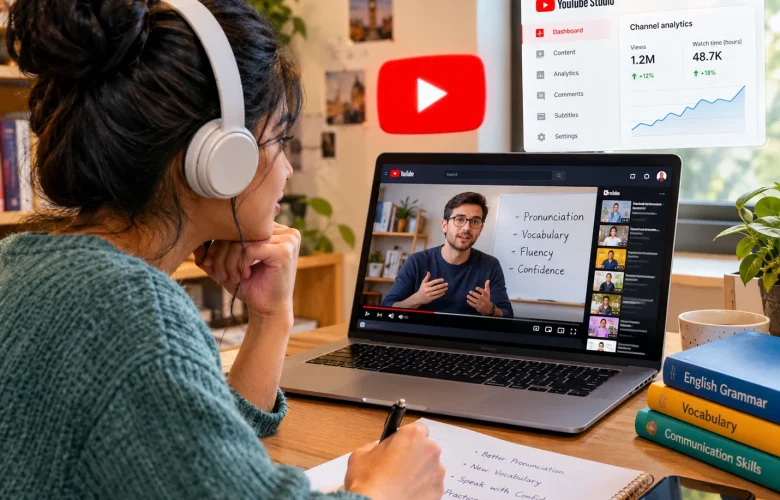
Let’s address the problem that many English learners face.
You can understand a video, remember a useful phrase, and even pronounce it correctly when repeating after the teacher. But when a colleague asks you a question unexpectedly, your brain suddenly opens 37 tabs, and none of them responds.
This is the gap between knowing English and using English.
YouTube is excellent for learning through listening, demonstrations, explanations, and examples. However, watching a video alone doesn’t automatically give you the experience of responding to another person in a live conversation.
That’s where MySivi can complement your learning routine.
Watch MySivi’s English-learning video: Fluent English in 15 Days!
MySivi is an English-speaking practice app featuring an AI tutor, designed to help learners practise conversations and develop their communication skills. Depending on the features available to your account, you can explore conversational scenarios and work on areas such as pronunciation, grammar, and sentence structure.
Here’s how to combine it with your favourite YouTube channels.
The Watch–Shadow–Speak Method
Step 1: Watch and learn
Choose a five-to-ten-minute lesson from BBC Learning English, English with Lucy, or another channel you enjoy.
Write down three useful expressions.
For example:
- “Let me think about that.”
- “From my point of view…”
- “Could you explain that again?”
Step 2: Shadow the speaker
Replay a short section and speak along with the speaker. Pay attention to pronunciation, pauses, word stress, and intonation.
Repeat the section until you can say it more comfortably.
Step 3: Speak using what you learned
Open MySivi and practice a relevant conversation where the appropriate feature is available.
If you learned expressions for sharing opinions, try using them in a discussion. If you learned interview vocabulary, practise answering interview-style questions.
Don’t simply repeat a memorised sentence. Respond to the question in your own words.
Step 4: Review and improve
Notice which expressions you used confidently and which ones were difficult to recall. Review the relevant lesson and practise again.
This approach gives you a practical way to connect listening, pronunciation, vocabulary, and speaking.
The aim isn’t to finish as many lessons as possible. It’s to make the language you learn easier to use when you need it.
A 20-Minute Daily Routine to Learn English with YouTube
You don’t need to spend three hours watching English videos every day. A short, focused routine is easier to maintain than an ambitious plan that disappears after Monday.
Here’s a simple 20-minute routine you can adapt to your schedule.
Time | Activity | What to do |
5 minutes | Watch | Choose one short English-learning video and understand its main idea. |
5 minutes | Learn | Note three useful expressions and check their meanings. |
5 minutes | Shadow | Repeat a short section, focusing on pronunciation and rhythm. |
5 minutes | Speak | Use the expressions in your own sentences or practise a conversation. |
You can adjust the timing based on your level. Beginners may need more time to understand new expressions, while advanced learners may prefer longer listening clips and more challenging discussions.
Your 7-Day English YouTube Challenge
Use this simple weekly plan to turn your subscriptions into an actual learning routine.
Day | Focus | Suggested resource |
Monday | Pronunciation | Rachel’s English |
Tuesday | Vocabulary | English with Lucy |
Wednesday | Listening | BBC Learning English |
Thursday | Natural conversation | Speak English With Vanessa |
Friday | English through entertainment | Learn English with TV Series |
Saturday | Personal growth | Matt D’Avella |
Sunday | Review and speaking | Reuse your favourite expressions with MySivi or a speaking partner |
At the end of the week, ask yourself:
- Can I recall the expressions I learned?
- Can I use them without reading my notes?
- Can I explain a topic for one minute in English?
- Which sounds, words, or situations still challenge me?
These questions help you measure progress through actual language use rather than the number of videos you’ve watched.
Common Mistakes to Avoid When Learning English on YouTube
Even the best English-learning channels won’t help much if your study habits prevent you from practising.
Mistake 1: Watching without speaking
Listening helps you understand English, but speaking requires you to produce language yourself.
Fix: Pause after useful sentences and repeat them aloud. Then create your own examples.
Mistake 2: Switching between too many channels
Following 25 teachers at once can leave you overwhelmed by different teaching styles, accents, and advice.
Fix: Choose two or three channels based on your current goals. Add more only when you have a clear reason.
Mistake 3: Memorising words without context
Knowing a word’s meaning doesn’t guarantee you’ll use it naturally.
Fix: Learn complete phrases and create sentences connected to your life.
Mistake 4: Depending entirely on subtitles
Subtitles can help, especially for beginners, but reading every word may keep you from training your listening skills.
Fix: Watch once without subtitles if the video is manageable. Then use English subtitles to check what you missed.
Mistake 5: Trying to eliminate your accent
A strong accent isn’t automatically a communication problem. Unclear sounds, misplaced stress, or difficulty being understood may be more important to address.
Fix: Focus on intelligibility, pronunciation, rhythm, and confidence rather than trying to sound exactly like someone else.
Mistake 6: Expecting instant fluency
A title promising fluency in a few days may be appealing, but sustainable progress depends on your starting level, practice, consistency, and opportunities to use English.
Fix: Set small goals. Learn three expressions, use them in conversation, and gradually increase the difficulty.
Remember: you don’t need perfect English to begin speaking. Speaking is one of the ways you improve.
Frequently Asked Questions (FAQs)
The best channel depends on your goal. Rachel’s English is useful for American pronunciation, English with Lucy for British English and vocabulary, BBC Learning English for structured listening practice, and the MySivi YouTube channel for everyday conversations. Choose according to your level and learning needs rather than subscriber count alone.
YouTube can help you improve listening, vocabulary, pronunciation, and grammar. However, watching alone doesn’t guarantee speaking fluency. Combine videos with shadowing, self-recording, speaking exercises, and conversations so you learn to retrieve and use expressions without relying on subtitles.
Yes. The channels listed in this guide offer YouTube content you can explore without paying for a separate course, although individual creators may also offer paid courses or other services. You can start with BBC Learning English, Rachel’s English, English with Lucy, Learnex, and other channels that match your goals.
Vox and Jared Henderson can provide challenging listening material covering social issues, culture, philosophy, and abstract ideas. Choose topics you’re interested in, write down unfamiliar expressions, and summarise the main argument in your own words. Advanced practice should challenge you without making every video impossible to understand.
Yes. Channels such as Matt D’Avella, Simple Happy Zen, and Lana Blakely can expose you to English used to discuss habits, relationships, confidence, and personal development. For the best learning experience, pause to record useful expressions and summarise what you’ve watched aloud.
Final Thoughts: Don't Just Watch English. Start Using It.
The best YouTube channels to learn English are the ones that help you make progress towards your specific goals.
If pronunciation is your priority, explore Rachel’s English. If you want to improve your British English, try English with Lucy. For listening practice, BBC Learning English is a useful starting point. If you prefer learning through entertainment, Learn English with TV Series can make practice more engaging.
And if you’re ready to go beyond watching, combine your lessons with regular speaking exercises and tools such as MySivi to practise using what you’ve learned.
You don’t need to understand every word in every video. You don’t need a perfect accent. And you certainly don’t need to wait until your grammar is flawless before opening your mouth.
Start small. Watch one video. Learn three expressions. Speak for five minutes.
Because the goal isn’t to become the person with the longest English-learning playlist.
It’s to become the person who can confidently use English when it actually matters.
Ready to take the next step? Watch MySivi’s English-learning video and build a practice routine that takes you from watching English to speaking it.

Sahil Gupta creates content around the MySivi app, helping learners improve their English speaking through simple, effective, and real-world methods, turning study stuff into simple, actually useful content. He shares English hacks, exam prep tips, and shows how to level up your speaking with MySivi’s AI-powered learning and real convo practice no fluff, just results