Want to reach a global audience on Instagram? Learn how Indian Instagram Influencers can improve English Speaking Skills with AI practice and confidence tips.
Speaking English confidently on Instagram can feel harder than creating the Reel itself.
You may know exactly what you want to say, have a great content idea, and even know your niche inside out—but the moment the camera turns on, words like “What if I pronounce this wrong?” or “What if people judge my English?” can suddenly take over.
If that sounds familiar, you’re definitely not alone.
For many Indian influencers and content creators, English isn’t necessarily the language they think in every day. Yet English can be useful when communicating with international viewers, brands, clients, collaborators, and online communities.
The good news? You don’t need perfect English to become a confident English-speaking influencer.
You need regular practice, useful vocabulary, better pronunciation, and the confidence to speak even when your sentences aren’t perfect.
This guide explains how Instagram influencers can improve their English-speaking skills, including practical exercises, AI-powered practice, vocabulary strategies, pronunciation tips, and a simple daily routine you can actually stick to.
Quick Answer: How Can Instagram Influencers Improve Their English Speaking Skills?
Instagram influencers can improve their English speaking skills by practicing aloud every day, recording Reels before publishing them, learning vocabulary related to their niche, using AI-powered speaking practice, listening to English creators, and reviewing common pronunciation and grammar mistakes.
A simple 15–20 minute daily routine can include:
- 5 minutes of listening
- 5 minutes of speaking
- 5 minutes of recording yourself
- 5 minutes of reviewing mistakes
The goal isn’t to sound like someone else.
The goal is to sound like a more confident version of yourself.
Key Takeaways
- Confidence matters more than perfection: Your audience connects with your personality, not just your grammar.
- Practice consistently: 15–20 minutes of daily speaking can be easier to maintain than occasional long study sessions.
- Use AI as a practice partner: An AI English tutor like MySivi can provide a private space to practice speaking.
- Practice with your actual content: Your next Reel can become your English-speaking exercise.
- Learn niche-specific vocabulary: A fashion creator doesn’t need the same vocabulary as a tech or finance creator.
- Record yourself: Listening to your own speech helps you notice pronunciation, pacing, filler words, and repeated mistakes.
- Don’t abandon your identity: English can expand your reach without replacing your regional language or personality.
Why Strong English Speaking Skills Matter for Instagram Influencers
Instagram is no longer only about posting attractive photos or entertaining Reels. For many creators, it has become a personal brand, portfolio, networking platform, and business channel.
English can help creators communicate with:
- International audiences
- Global brands
- PR agencies
- Freelance clients
- Other creators
- Podcast hosts
- Event organizers
- International communities
Strong English communication skills can also make collaborations easier for influencers. Whether you’re explaining a product, negotiating a campaign, answering questions on a Live, or recording a brand video, clear communication can make your message easier to understand.
But here’s an important point:
Speaking English doesn’t automatically make content better. Relevant, authentic content still comes first.
A useful real-world example is Indian creator Madan Gowri. YourStory reported that he initially created content in both English and Tamil, but later focused more heavily on Tamil after seeing stronger audience response. His experience shows an important lesson for creators: language strategy should follow the audience and the content—not the assumption that English is always better.
So, if you’re an Indian influencer, don’t think of English as a replacement for Hindi, Tamil, Bengali, Telugu, Marathi, or any other language.
Think of it as another communication tool in your creator toolkit.
English vs Regional Language: What Should Indian Influencers Use?
You don’t necessarily have to choose one.
Your language strategy can depend on your niche, audience, location, and content goal.
Content Goal | Possible Language Strategy |
Reach local Indian audiences | Regional language or Hinglish |
Build an international audience | English or bilingual content |
Connect emotionally with Indian viewers | Mother tongue/regional language |
Work with global brands | Clear English communication |
Explain technical topics | English + regional-language explanations |
Experiment with new audiences | Bilingual Reels and English captions |
The smartest approach is often audience-first, rather than simply choosing English because it sounds more professional.
How to Speak English Confidently in Instagram Videos: Step-by-Step Guide
Confidence doesn’t magically appear when you press Record.
It develops through repetition.
Here’s a practical process you can use before your next Reel.
Step 1: Practice with an AI English Tutor Before You Record
One of the biggest challenges for influencers is the fear of making mistakes in front of an audience.
Imagine being able to practice the same Reel introduction five times without anyone judging you.
That’s where an AI English-speaking app can help.
With a tool such as MySivi AI, creators can practice spoken English privately before using it in public content.
You can practice conversations around topics that actually match your niche:
- Fashion reviews
- Tech products
- Travel experiences
- Food reviews
- Fitness advice
- Beauty tutorials
- Business topics
- Personal stories
- Interview-style questions
Why Topic-Based Practice Works
Random vocabulary exercises can become boring pretty quickly.
Creator-focused practice is different because you’re learning English that you can actually use.
For example:
Instead of learning:
“The weather is pleasant today.”
Practice:
“Today I’m taking you to one of my favourite hidden cafés in Delhi.”
The second sentence is directly usable in content.
MySivi AI Practice Benefits
The original article highlights several ways MySivi AI can support speaking practice, including topic-based conversations, feedback, progress tracking, and group calls.
Practice Need | How It Helps a Creator |
Topic-based conversation | Practice language related to your niche |
Pronunciation feedback | Identify words that need clearer pronunciation |
Grammar feedback | Notice recurring sentence errors |
Fluency practice | Become more comfortable speaking continuously |
Progress tracking | Monitor improvement over time |
Group speaking | Get comfortable communicating with different people |
Pro tip: Don’t wait until your English is “good enough” to practice.
Practice is how it becomes good enough.
Step 2: Script and Rehearse Your Instagram Reels
You don’t need to write a Shakespeare-level script.
In fact, simpler is often better.
Before recording a Reel, write down:
Hook → Main Point → Example → Call to Action
For example:
Hook: “Still translating every sentence in your head before speaking English?”
Main Point: “Here’s one simple habit that helped me speak more naturally.”
Example: Explain the habit.
CTA: “Try it today and tell me how it goes.”
Then read it aloud.
The 3-Take Method
Try recording your Reel three times:
Take | Focus |
Take 1 | Just speak—don’t worry about mistakes |
Take 2 | Improve pronunciation and sentence clarity |
Take 3 | Focus on natural delivery and confidence |
This removes the pressure of getting everything perfect on the first try.
And honestly, first-take perfection is overrated.
Step 3: Build Vocabulary Around Your Niche
You don’t need 10,000 fancy English words to become a confident creator.
You need the right words for your content.
Create a list of 20–30 useful words and phrases for your niche.
Influencer Niche | Useful English Vocabulary & Phrases |
Fashion | flattering, silhouette, fabric, styling, outfit, versatile |
Beauty | skincare routine, texture, lightweight, coverage, finish |
Tech | user interface, performance, seamless, feature, battery life |
Travel | hidden gem, breathtaking, local experience, itinerary |
Food | crispy, creamy, aroma, flavour, texture, must-try |
Fitness | workout routine, strength, flexibility, recovery |
Finance | investment, savings, returns, budget, financial goals |
Lifestyle | productivity, routine, mindset, habits, work-life balance |
Don’t just memorize these words.
Use them.
Create a sentence.
Say it aloud.
Use it in a Reel.
Use it in a caption.
Use it in a DM.
That’s how passive vocabulary becomes active vocabulary.
Step 4: Record Yourself and Listen Back
This is one of the simplest—and most underrated—English speaking exercises for content creators.
Record a 30–60 second video.
Then listen to it without looking at the screen.
Ask yourself:
- Am I speaking too quickly?
- Am I swallowing words?
- Do I use “um,” “like,” or “actually” too often?
- Am I repeating the same words?
- Is my pronunciation clear?
- Do my sentences sound natural?
- Do I sound confident?
- Am I pausing in the right places?
Don’t criticize yourself.
Audit yourself like a creator.
You already review your content for lighting, framing, thumbnails, and editing. Your voice deserves the same attention.
Step 5: Learn to Think in English
A common challenge for English learners is mentally translating:
Hindi → English → Speak
That extra step can make speaking slower.
Instead, start with simple thoughts directly in English.
For example:
Instead of mentally translating:
“Mujhe aaj ek Reel banani hai.”
Try thinking:
“I need to make a Reel today.”
Start with everyday thoughts:
- “I am hungry.”
- “I need to reply to this message.”
- “This video looks good.”
- “I should record this again.”
- “I need a better hook.”
You don’t need complicated English.
Simple English spoken naturally beats complicated English spoken nervously.
Step 6: Use English in Your Captions, Comments and DMs
Speaking practice shouldn’t stop when you finish recording.
Turn your social media activity into a mini English classroom.
Try:
Captions
Write one or two sentences in English.
Comments
Leave thoughtful English comments on creators in your niche.
DMs
Practice short, professional messages when communicating with brands or collaborators.
Stories
Use English for polls, questions, and short updates.
For example:
Instead of:
“What should I post next?”
Try:
“What would you like to see next?”
Small changes add up.
Step 7: Practice Common Pronunciation Problems
Many Indian English speakers may notice particular pronunciation challenges, but there’s no need to be embarrassed.
They are simply areas you can practice.
1. W and V
Practice:
- wine/vine
- west/vest
- wet/vet
For the W sound, your lips should form a rounded shape.
2. Word Stress
English relies heavily on word stress.
For example, practice the difference in stress when saying:
- PREsent vs preSENT
- REcord vs reCORD
Listening and repeating can help you develop better rhythm.
3. Tense Consistency
Instead of:
“Yesterday, I go to the mall.”
Say:
“Yesterday, I went to the mall.”
Don’t try to fix everything at once.
Choose one recurring mistake, practice it, and then move to the next.
A Real Creator Case Study: Madan Gowri and the Language Question
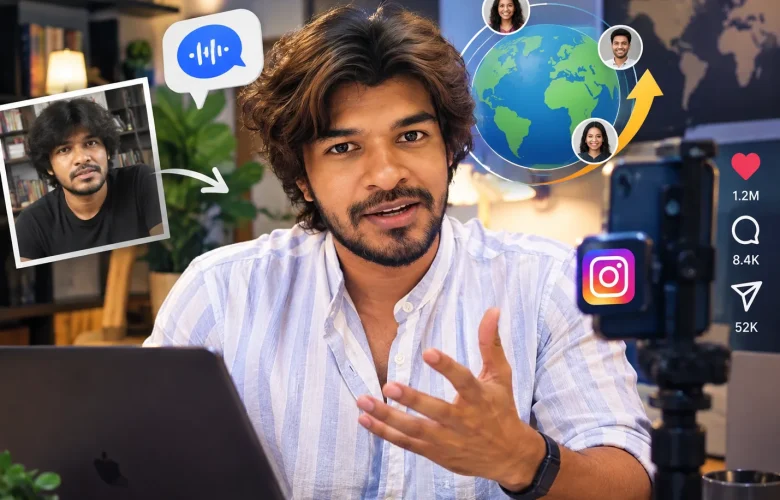
A useful case study comes from Indian YouTube creator Madan Gowri.
In an interview with YourStory, Gowri explained that he initially created videos in both English and Tamil. He later shifted more toward Tamil after noticing that Tamil content was receiving a stronger audience response and that there was a significant gap in Tamil-language content. His content subsequently reached audiences beyond India as well.
What Can Influencers Learn From This?
The lesson isn’t “speak English to grow.”
It’s more nuanced:
Choose your language based on the audience you want to serve.
For an influencer trying to improve English, this means you don’t have to suddenly turn every Reel into an English-only video.
Instead, experiment.
Experiment | What to Observe |
English Reel | International reach and watch time |
Regional-language Reel | Local engagement and comments |
Hinglish Reel | Audience retention and relatability |
English captions | Discoverability and accessibility |
Bilingual Reel | Audience response across segments |
Keep your best-performing format and continue testing.
This is a much more sustainable strategy than copying another creator’s language style.
A 15-Minute Daily English Routine for Influencers
Busy creators don’t necessarily need a one-hour English class every day.
Try this instead:
Time | Activity | Goal |
3 min | Listen to an English creator | Learn rhythm and phrasing |
4 min | AI speaking practice | Speak without pressure |
3 min | Learn 3–5 niche phrases | Build relevant vocabulary |
3 min | Record yourself | Improve delivery |
2 min | Review one mistake | Create focused improvement |
The 7-Day Creator Speaking Challenge
Day 1: Introduce yourself in English.
Day 2: Explain your niche.
Day 3: Review a product.
Day 4: Tell a short personal story.
Day 5: Explain a trending topic.
Day 6: Record a 60-second Reel without reading a script.
Day 7: Re-record Day 1 and compare.
You may be surprised by the difference.
English Speaking Mistakes Influencers Should Avoid
Improving English doesn’t mean using complicated vocabulary.
Avoid these common habits:
Instead of… | Try… |
Using very difficult words | Use clear, familiar words |
Speaking extremely fast | Slow down slightly |
Memorizing every sentence | Remember key points |
Translating every thought | Practice thinking in English |
Copying another creator’s accent | Develop your natural speaking style |
Avoiding English because of mistakes | Treat mistakes as feedback |
Using too many fillers | Pause naturally |
Remember:
Accent ≠ lack of fluency.
You don’t need to erase your Indian identity or sound like an American or British creator.
Clear communication matters more than copying an accent.
How to Sound More Confident in English on Camera
Confidence is partly language skill and partly presentation.
Before recording:
- Sit or stand upright.
- Take one slow breath.
- Look at the camera lens.
- Smile naturally.
- Start with a strong opening sentence.
- Speak slightly slower than normal.
- Pause instead of filling silence with “umm.”
- Focus on communicating—not performing perfect English.
If you make a mistake, don’t panic.
Pause.
Restart the sentence.
Keep going.
Your audience will usually care far more about what you’re saying than whether every sentence is grammatically perfect.
What About Gen Z English?
If your audience is young, natural conversational language can make your content feel more relatable.
You can occasionally use expressions such as:
- “That’s a vibe.”
- “Let’s break it down.”
- “Here’s the catch.”
- “This one is actually useful.”
- “Okay, hear me out.”
- “Low-key, this works.”
- “Let’s keep it simple.”
But don’t force slang into every sentence.
Natural > trendy.
Using Gen Z expressions only works when they match your personality and audience.
How AI Can Help Content Creators Improve English Speaking
AI can make speaking practice more accessible because creators can practice when it fits their schedule.
For a content creator, that could mean:
Before work → 10 minutes of speaking practice
Before recording → Practice the Reel topic
After recording → Review common mistakes
At night → Learn a few new phrases
An AI English tutor can be particularly useful when you don’t have a speaking partner available.
However, AI should complement, not completely replace, real human communication.
Once you feel comfortable, practice with:
- Friends
- Fellow creators
- Learner communities
- Professional contacts
- Brand teams
- English-speaking audiences
The goal is to move from practice English → real-world English.
Frequently Asked Questions(FAQs)
Practice English every day through speaking, listening, recording, and real conversations. Use your own content as practice by scripting short Reels, explaining your niche in English, and reviewing your recordings.
Start with simple English, speak at a comfortable pace, rehearse important Reels, learn vocabulary related to your niche, reduce filler words, and practice speaking regularly.
Start privately. Record yourself without publishing the video, practice with an AI English tutor, and gradually move to Stories and Reels. The more often you hear yourself speaking English, the more familiar it feels.
Yes. AI-powered speaking tools can provide a convenient way to practice pronunciation, grammar, vocabulary, and conversational English. They are especially useful for creators who don’t always have a speaking partner available.
You can practice by recording yourself, using an AI English speaking app such as MySivi, shadowing English speakers, reading scripts aloud, and speaking about your daily activities.
Focus on vocabulary connected to your niche. Start with 20–30 useful words and phrases, then use them in sentences, captions, Stories, and Reels instead of simply memorizing definitions.
Practice short conversations every day, prepare your main points before recording, speak at a comfortable pace, learn useful phrases, and gradually reduce your dependence on scripts.
No. A native accent isn’t a requirement for successful content. Clear pronunciation, understandable speech, confidence, authenticity, and useful content are more important than copying another person’s accent.
Not necessarily. English can help reach certain audiences, but regional-language and bilingual content can also be highly effective. Test different formats and use audience response to guide your content strategy.
Final Thoughts: Your English Doesn't Have to Be Perfect
For an Instagram influencer, English is not a test you need to pass.
It’s a communication skill you can build.
You don’t need perfect grammar before recording your first English Reel. You don’t need an expensive classroom. And you definitely don’t need to hide your accent.
Start small.
Practice for 15 minutes.
Record one short video.
Learn three useful phrases.
Fix one pronunciation mistake.
Then do it again tomorrow.
Over time, those small repetitions can turn hesitation into confidence.
And when you’re ready, use an AI English speaking practice tool such as MySivi AI to make your practice more consistent, personalized, and comfortable.
Because the goal isn’t to sound perfect.
The goal is to speak, connect, and be understood—with confidence.
Quick 7-Day Action Plan
Day | Your English-Speaking Task |
Monday | Introduce yourself in English |
Tuesday | Explain your content niche |
Wednesday | Learn and use 5 niche-specific words |
Thursday | Record a 60-second product/topic review |
Friday | Practice pronunciation with AI |
Saturday | Publish or rehearse an English Reel |
Sunday | Compare your recording with Monday’s |
Start with one Reel. One conversation. One sentence.
That’s how fluency grows.

Sahil Gupta creates content around the MySivi app, helping learners improve their English speaking through simple, effective, and real-world methods, turning study stuff into simple, actually useful content. He shares English hacks, exam prep tips, and shows how to level up your speaking with MySivi’s AI-powered learning and real convo practice no fluff, just results