Master the English skills for PR & media careers. This guide covers the essential vocabulary, grammar, and speaking tips you need to succeed in India.
Stood in front of a journalist and had your mind go blank? You know the message and have the press release, but finding the right English words under pressure can feel impossible. For ambitious public relations and media professionals in India, this moment can be the difference between a story that flies and one that flops.
That gap between knowing your strategy and communicating it with impact is where careers are made. This guide is your bridge. We will break down the exact English skills for PR and media careers you need, from handling a tough Q&A to writing a persuasive pitch, and show you how to master them.
The best way to improve is through consistent practice in realistic scenarios. An AI English-speaking app like MySivi provides a platform to rehearse press briefings, journalist calls, and client pitches, offering instant feedback on your fluency, grammar, and pronunciation without the fear of making mistakes in a high-stakes environment.
Key Takeaways
Clarity is King: In PR and media, clear, concise, and persuasive English is non-negotiable for building trust with journalists and stakeholders.
Vocabulary Matters: Using precise terms like “embargo,” “boilerplate,” and “pitch” demonstrates industry knowledge and professionalism.
Speaking Under Pressure: Fluency is crucial. You must be able to handle unexpected questions from journalists and deliver key messages confidently.
Grammar Builds Credibility: Flawless grammar in press releases, emails, and social media posts is essential for maintaining your brand’s reputation.
Consistent Practice Is the Solution: An AI English tutor helps you practice real-world scenarios and target your weak points for rapid improvement.
Why Is English So Important in PR and Media?
In the fast-paced world of public relations and media in India, English is the primary language of business. From pitching to national media houses to managing the reputation of global brands, strong English skills are not just an advantage; they are a fundamental requirement. A study by the Associated Chambers of Commerce and Industry of India (ASSOCHAM) has previously highlighted that a lack of English communication skills can be a significant barrier to career growth in corporate India. For a public relations professional, this is doubly true.
Your job is to build and protect a reputation. Every email, press release, and interview is a reflection of your client or company. Grammatical errors, poor phrasing, or a hesitant speaking style can undermine your credibility and the message you are trying to convey.
What English Skills Do PR and Media Professionals Need?
Success in this field requires a specific blend of language skills. It’s not just about being fluent; it’s about being strategic with your words.
1. Polished and Persuasive Speaking Skills
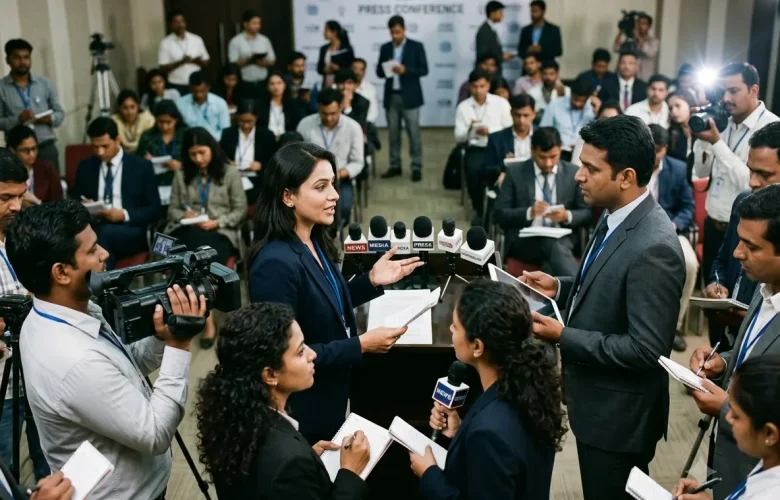
This is where the pressure is highest. Whether you’re in a one-on-one interview or a crowded press conference, your spoken English must be impeccable.
Clarity and Conciseness: Can you explain a complex issue in two simple sentences? Media professionals are busy; they appreciate clear, direct communication.
Confident Delivery: This involves your tone, pace, and body language. You need to sound authoritative and trustworthy.
Handling Q&As: You must think on your feet, understand nuanced questions from journalists, and respond diplomatically without getting flustered.
How MySivi AI Helps: The most effective way to build these English-speaking skills for PR professionals is to practise. MySivi AI lets you simulate press conferences and journalist calls. You can practise delivering key messages and answering tough questions, and your AI English tutor will provide instant feedback on your pronunciation, fluency, and use of filler words.
2. Strategic PR & Media Vocabulary
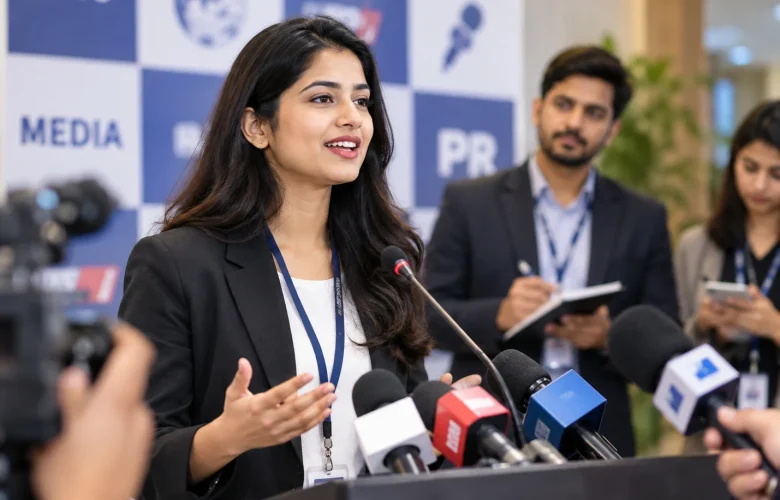
Using the right terminology shows you belong in the industry. It builds instant rapport with journalists and stakeholders.
Here is a table of essential English vocabulary for PR professionals, along with their meanings and a sample sentence.
Term | Meaning (in English) | Meaning in Hindi | Example Sentence |
Embargo | A request not to publish information until a specific date or time. | प्रकाशन पर रोक | “The press release is under strict embargo until 10 AM tomorrow.” |
Boilerplate | A standard block of text about a company, usually placed at the end of a press release. | मानक परिचयात्मक पाठ | “Please include the official company boilerplate in the final draft.” |
Pitch | A persuasive message sent to a journalist to encourage them to cover a story. | प्रस्ताव / कहानी का प्रस्ताव | “I’m sending a pitch to the tech editor about our new product launch.” |
Press Kit | A package of promotional and informational materials provided to the media. | प्रेस किट | “The digital press kit includes high-resolution images and executive bios.” |
Angle | The specific viewpoint or focus of a news story. | दृष्टिकोण / विषय का विशेष पहलू | “We need a stronger news angle to make this story interesting for the media.” |
Media Relations | The work of building and maintaining relationships with journalists and media organizations. | मीडिया संबंध | “Our media relations strategy focuses on building trust with key reporters.” |
Press Release | An official statement issued to the media to announce news or information. | प्रेस विज्ञप्ति | “The team issued a press release announcing the product launch.” |
Journalist | A person who researches, writes, or reports news for the media. | पत्रकार | “The journalist requested an interview with our CEO.” |
Media Outlet | A newspaper, magazine, website, TV channel, or other organization that publishes news. | मीडिया संस्थान | “The story was featured in several major media outlets.” |
Coverage | Publicity or reporting about a person, company, event, or story in the media. | मीडिया कवरेज | “The campaign received extensive media coverage.” |
Earned Media | Publicity gained through media coverage rather than paid advertising. | अर्जित मीडिया कवरेज | “The startup generated strong earned media through its product announcement.” |
Owned Media | Content published through channels controlled by an organization, such as its website or blog. | स्वामित्व वाला मीडिया | “Our company blog is an important owned media channel.” |
Paid Media | Media exposure that an organization pays for, such as advertisements or sponsored content. | भुगतान किया गया मीडिया | “The campaign used paid media to reach a wider audience.” |
Media List | A list of relevant journalists, editors, publications, and media contacts. | मीडिया संपर्क सूची | “Update the media list before sending the announcement.” |
Target Audience | The specific group of people a communication campaign aims to reach. | लक्षित दर्शक | “Young professionals are the target audience for this campaign.” |
Key Message | The main point or idea an organization wants its audience to understand. | मुख्य संदेश | “The key message should remain consistent across all communications.” |
Talking Points | Important points prepared for a spokesperson to communicate during an interview or event. | बातचीत के मुख्य बिंदु | “The PR team prepared talking points for the CEO’s interview.” |
Spokesperson | A person authorized to speak publicly on behalf of an organization. | प्रवक्ता | “The company spokesperson addressed questions from the media.” |
Statement | An official comment or declaration issued by an individual or organization. | आधिकारिक बयान | “The company released a statement regarding the incident.” |
Newsworthy | Interesting or important enough to attract media attention. | समाचार योग्य | “The research findings are highly newsworthy.” |
Headline | The title of a news story, article, or press release. | शीर्षक | “Write a clear and attention-grabbing headline for the press release.” |
Byline | The name of the person who wrote an article or piece of content. | लेखक का नाम | “The journalist’s name appears in the byline.” |
Exclusive | A story or information provided to only one media outlet or journalist. | विशेष समाचार / एक्सक्लूसिव | “The publication was given an exclusive interview with the founder.” |
Follow-up | Additional communication with a journalist after an initial pitch or interaction. | अनुवर्ती संपर्क | “I’ll send a follow-up email if the journalist doesn’t respond.” |
Media Inquiry | A request for information, comments, or an interview from a media professional. | मीडिया पूछताछ | “We received a media inquiry about the company’s expansion plans.” |
Media Training | Training that prepares executives or spokespeople to communicate effectively with journalists. | मीडिया प्रशिक्षण | “The CEO completed media training before the television interview.” |
Crisis Communication | Communication used to manage and respond to a situation that could harm an organization’s reputation. | संकट संचार | “The company activated its crisis communication plan after the incident.” |
Reputation Management | The process of monitoring and influencing how an organization or person is perceived publicly. | प्रतिष्ठा प्रबंधन | “Reputation management is an important part of corporate PR.” |
Press Conference | An organized event where journalists are invited to hear announcements and ask questions. | प्रेस कॉन्फ्रेंस / पत्रकार सम्मेलन | “The company held a press conference to announce the acquisition.” |
Press Briefing | A meeting where an organization provides information and answers questions from journalists. | प्रेस ब्रीफिंग | “The spokesperson conducted a press briefing for reporters.” |
Media Monitoring | Tracking news coverage and mentions of an organization, person, or topic. | मीडिया निगरानी | “Our team uses media monitoring to track brand mentions.” |
Sentiment | The overall positive, negative, or neutral attitude expressed toward a brand or topic. | भावना / जनभावना | “The team analyzed social media sentiment after the announcement.” |
Media Training | Preparation that helps spokespeople handle interviews and media questions effectively. | मीडिया प्रशिक्षण | “The executive attended media training before speaking with reporters.” |
Byline Article | An article published under the name of a company executive or expert. | लेखक के नाम से प्रकाशित लेख | “The CEO contributed a byline article to the business magazine.” |
Thought Leadership | Sharing expert knowledge and insights to establish authority in a particular field. | विचार नेतृत्व | “The campaign aims to position the founder as a thought leader.” |
Brand Voice | The consistent style, personality, and tone a brand uses in its communication. | ब्रांड की संचार शैली | “The PR team ensures that every statement matches the company’s brand voice.” |
Stakeholder | A person or group affected by or interested in an organization’s activities. | हितधारक | “We communicated the changes clearly to all key stakeholders.” |
Campaign | A planned series of communication activities designed to achieve a specific goal. | अभियान | “The PR campaign generated significant awareness for the new product.” |
Outreach | The process of contacting journalists, influencers, organizations, or other relevant people. | संपर्क अभियान | “The team started media outreach two weeks before the launch.” |
Press Coverage | News articles, broadcasts, or online mentions about an organization or event. | प्रेस कवरेज | “The event received positive press coverage.” |
Media Training | Preparation for interviews, press conferences, and other interactions with journalists. | मीडिया प्रशिक्षण | “The spokesperson received media training before the product announcement.” |
Crisis Management | The process of handling an event that threatens an organization’s reputation or operations. | संकट प्रबंधन | “Effective crisis management helped the company respond quickly.” |
Publicity | Attention or exposure received from the public or media. | प्रचार / सार्वजनिक चर्चा | “The event generated considerable publicity for the brand.” |
Press Contact | A journalist, editor, or media professional who can be contacted for PR purposes. | प्रेस संपर्क | “Add the new technology reporter to our press contacts.” |
Media Exposure | The amount of visibility a person, brand, or organization receives through media channels. | मीडिया में दृश्यता | “The announcement generated significant media exposure.” |
Key Opinion Leader (KOL) | A person recognized as an influential expert or voice within a particular field or community. | प्रमुख विचार प्रभावक | “The campaign partnered with KOLs in the education sector.” |
Influencer Outreach | The process of contacting influencers for collaborations, campaigns, or publicity. | प्रभावशाली व्यक्तियों से संपर्क | “The PR team began influencer outreach before the campaign launch.” |
Press Mention | A reference to a person, brand, or organization in a media publication. | प्रेस में उल्लेख | “The startup received several press mentions after its funding announcement.” |
Media Training | Coaching designed to help professionals communicate confidently and effectively with the media. | मीडिया प्रशिक्षण | “The founder completed media training before the interview.” |
3. Flawless Grammar and Writing
Your written communication is often the first impression a journalist or client has of you. There is zero room for error.
Press Releases: Must be grammatically perfect, clear, and follow a standard format.
Email Pitches: A single typo can get your email deleted. Your writing must be crisp and professional.
Social Media Updates: Represent the brand’s voice. Errors can damage credibility instantly.
A common mistake is the incorrect use of prepositions (e.g., “on behalf of” vs. “in behalf of”) or subject-verb agreement in complex sentences. These small errors can signal a lack of attention to detail, a fatal flaw in PR. As detailed in Purdue University’s Online Writing Lab ([Purdue OWL](https://owl.purdue.edu/owl/purdue_owl.html)), mastering these nuances is critical for professional writing.
How MySivi AI Helps: While practising your speaking, MySivi AI also analyses your sentence structure and grammar. When you consistently make a grammatical mistake in your speech, the AI flags it, helping you identify and correct deep-rooted errors that also appear in your writing. This is a core part of effective public relations training.
How Can I Improve My English for a PR Career?
Improving your English for public relations requires a targeted approach. General English courses often miss the specific skills media-facing roles require.
- Read Industry Publications: Regularly read outlets like The Economic Times, Livemint, and global sources like the Financial Times. Pay attention to the language and sentence structure used. This also helps you stay updated for international relations roles.
- Practise Mock Interviews: Don’t wait for a real PR interview to test your skills. Use an AI tutor to practise answering common questions like, How would you handle a crisis? or “Pitch me a story.”
- Record Yourself: Use your phone to record yourself delivering a one-minute summary of a news article. Listen back and note your pace, use of “ums” and “ahs,” and overall clarity.
- Use an AI Practice Partner: This is the most efficient method. An app like MySivi is designed for this. You can choose topics like “Handling a Negative Public Relations Review” or “Client Pitch Meeting” and have a full conversation. The AI adapts to your level, tracks your vocabulary and fluency, and gives you a safe space to build confidence.
Frequently Asked Questions(FAQs)
The most crucial skills are clarity, conciseness, and the ability to adapt your tone for different audiences. Strong writing and grammar for scripts and articles, combined with confident speaking for interviews and presentations, are essential for credibility in any media career.
Use an AI tutor like MySivi AI to simulate interview scenarios. Practice answering questions about crisis management, campaign strategy, and media relations. This allows you to get comfortable speaking about your experience and ideas under pressure, with instant feedback to help you improve.
Key vocabulary includes terms like “press release,” “embargo,” “boilerplate,” “pitch,” “media kit,” “angle,” and “crisis communications.” Using this PR English correctly demonstrates your industry knowledge and professionalism to journalists and clients.
Perfect English grammar for PR professionals is vital because every written document—from a tweet to a press release—represents the brand. Errors can make a company look unprofessional and untrustworthy, undermining the entire purpose of public relations.
Strong, confident English helps build rapport and trust with journalists. It allows a PR professional to pitch stories clearly, answer questions precisely during Q&As, and handle difficult conversations with diplomacy, ensuring the journalist sees them as a reliable source.
Key speaking skills include confident delivery, a clear and steady pace, the ability to simplify complex topics, and active listening. You must be persuasive when pitching and calm and authoritative when managing a crisis or difficult interview.
Yes. An AI English teacher provides a non-judgmental space to practise job-specific conversations 24/7. Apps like MySivi offer targeted exercises for media scenarios, provide instant feedback on pronunciation and grammar, and track your progress, making it a highly efficient way to prepare for a media career.
Conclusion
For a successful career in public relations or media in India, mastering English is not just about learning a language—it’s about mastering the art of communication. Your ability to speak clearly, write persuasively, and use the right vocabulary directly impacts your effectiveness as a public relations professional. While reading and listening are important, nothing replaces the act of speaking. Consistent, targeted practice is the key to building the confidence and fluency needed to excel under pressure.
Ready to build the communication skills that will define your career? Start practising with MySivi AI today and turn your potential into your profession.

Sahil Gupta creates content around the MySivi app, helping learners improve their English speaking through simple, effective, and real-world methods, turning study stuff into simple, actually useful content. He shares English hacks, exam prep tips, and shows how to level up your speaking with MySivi’s AI-powered learning and real convo practice no fluff, just results